MCP Standard for AI Agents: Building Scalable Workflows
Learn how the Model Context Protocol (MCP) enables AI agents to integrate with workflow systems. Discover why MCP matters for team operations at scale.
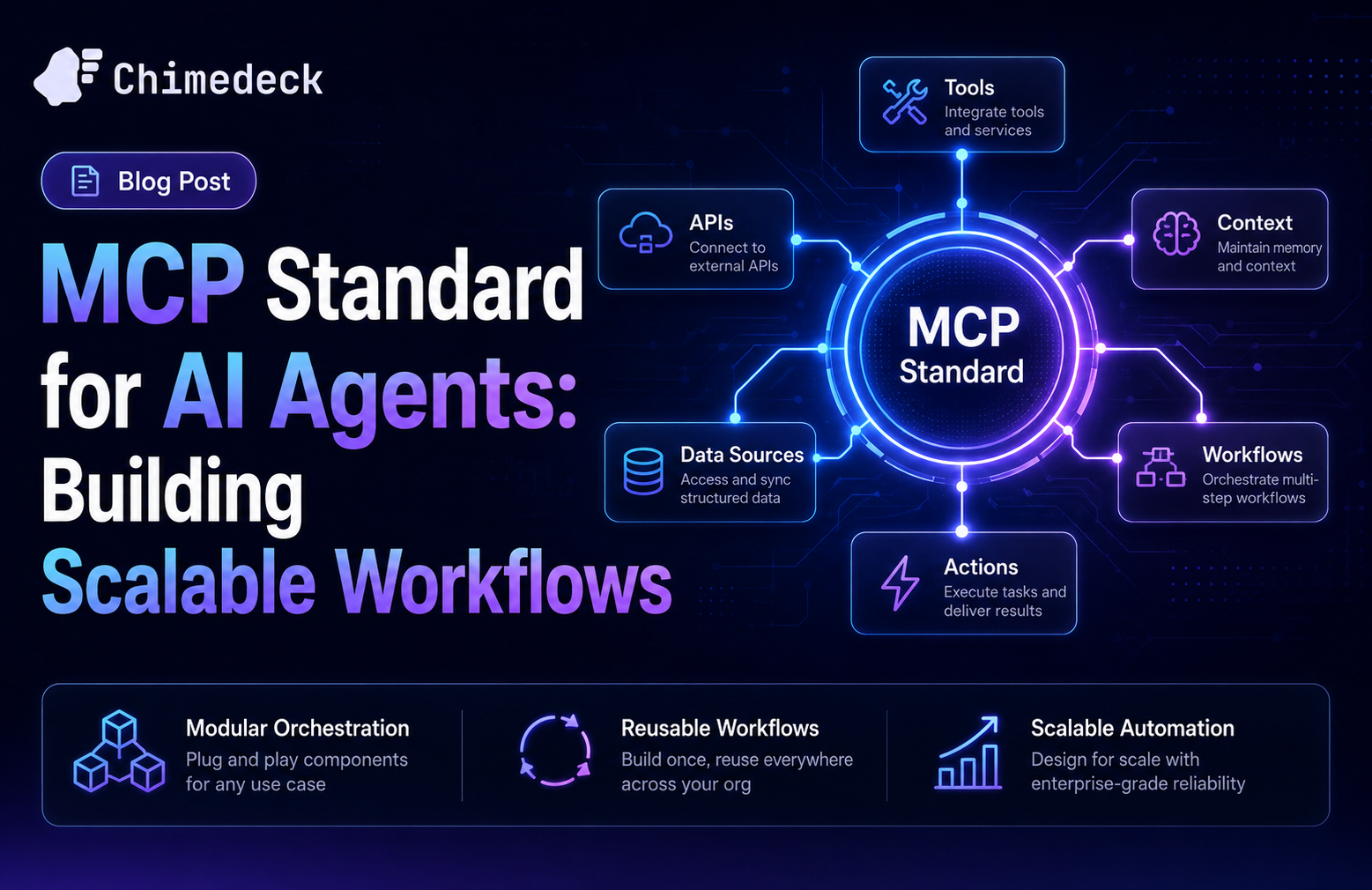
The Model Context Protocol (MCP) has quietly become central to how teams think about AI agents in their operations. If you're evaluating how AI can actually improve your workflows, you'll hear about it eventually. The reason isn't hard to understand: MCP solves a specific problem that emerges when you move beyond single-tool AI integrations and start thinking about connected, agentic workflows across your entire operation.
Teams building with AI agents quickly realise that isolated integrations don't scale. An AI tool that can only talk to one system is useful in narrow contexts, but it becomes a bottleneck when you need agents to orchestrate work across multiple platforms. This is where MCP enters the picture as a standardised way for AI systems to interact with the platforms and tools where your actual work lives. Go with Chimedeck now!!!

Understanding MCP as a bridge for AI agents
The Model Context Protocol is, at its core, a standardised framework for connecting AI applications to external systems. Rather than each AI tool requiring custom connectors to every external system, MCP establishes a universal protocol that both AI clients and data systems can implement. Think of it as a plug-and-play standard for AI integration, similar to how USB became the standard for hardware connectivity.
For AI agents specifically, this standardisation is crucial. An MCP agent tasked with managing team workload needs to access project management systems, check calendar availability, pull data from databases, and potentially trigger actions in other tools. Without a standard like MCP, building that agent requires custom integration work for every single connection. With MCP, those connections become more predictable and faster to implement.
Early implementations show the practical benefit. Agents can now access your Google Calendar and internal databases simultaneously, analyse information from disparate sources, and make decisions based on integrated context. This capability only works reliably when the underlying protocol is standardised, which is precisely what MCP provides.
The protocol itself is open-source and developed collaboratively, with support from Anthropic, OpenAI, and developer tool companies like Visual Studio Code and Cursor. This broad ecosystem support means that MCP implementations built today will remain relevant across multiple AI platforms and tools, reducing the risk of lock-in.
=>>> Read More: MCP Agent Repos: Building AI Workflows at Scale
MCP Standard for AI Agents: Building Scalable Workflows
From isolated AI tools to integrated workflows
Many teams currently use AI in fragmented ways. A marketing team uses one AI tool for copywriting, another for data analysis, and a third for workflow automation. None of these tools speak to each other, and each requires manual integration with company systems. The result is operational friction: teams end up switching between interfaces, manually moving data between tools, and coordinating workflows manually.
MCP-compliant AI agents change this dynamic. Instead of integrating each tool separately with your systems, you build a single set of MCP servers that expose your company's data and workflows. Any MCP-compatible AI client (whether that's Claude, ChatGPT, or a custom agent) can then access that standardised interface. This is a fundamental shift from tool-centric to system-centric thinking about AI.
For teams managing projects, this means an AI agent can access task data, understand team capacity, check dependencies, and suggest optimisations or handle routine updates without human intervention. The agent isn't just a writing assistant or a chatbot; it becomes a genuine operational tool that understands context across your entire workflow.
This level of integration requires that your underlying workflow system can expose its data and operations via MCP. Not every project management tool supports this yet, which is why the choice of your baseline platform matters. You need a system flexible enough to integrate with modern standards like MCP, not one locked into proprietary integrations.
Implementing MCP in workflow systems
If your team decides to move forward with MCP-based AI agents, the implementation path depends on your current tooling. Some organisations start by building MCP servers that wrap existing legacy systems, exposing task data, user information, and operational metrics through the standard protocol. This is a common pattern for enterprises with established infrastructure.
Other teams take a greenfield approach: they select a new platform specifically chosen for its extensibility and MCP compatibility, then build AI integrations from day one. This path has lower technical debt but requires migration effort. The decision depends on whether your current systems are worth retrofitting or whether a clean break makes sense.
A practical consideration emerges quickly: complexity. Building robust MCP servers requires security thinking. Your AI agent will be accessing real operational data and potentially taking real actions. If the agent's context window gets polluted or its reasoning goes wrong, the impact is real. This means you need audit trails, permission controls, and graceful failure modes. MCP as a protocol is sound, but the implementation burden on your team is real.
This is why some organisations choose platforms that have MCP support built in rather than bolting it on afterward. A platform designed from the start to expose operations through standardised protocols tends to have better security controls and operational safeguards already embedded.

=>>> Read More: What is an MCP Agent? Model Context Protocol Explained
MCP and scalable team operations
Where MCP really justifies its existence is at scale. A five-person team might muddle through with disconnected tools and manual workarounds. A fifty-person team needs orchestration. An MCP standard makes that orchestration possible without building custom integration code for every new tool or system.
Consider an agency managing multiple clients. Each client has different tools: one uses Asana, another Trello, a third has custom internal systems. Without MCP, your team needs custom integrations for each client's stack. With MCP, as long as each client's system supports the protocol, your AI agents can work across them seamlessly. This is a scaling advantage that compounds as your operation grows.
The financial impact is also real. Per-seat SaaS pricing becomes painful at scale. If you're integrating multiple systems and they all charge per user, costs escalate quickly. Open-source alternatives built on MCP can be cheaper to operate, especially if deployed self-hosted. For teams growing faster than their budgets, this matters significantly.
Another operational benefit: flexibility. If you select a workflow system that's open-source and MCP-compatible, you're not locked into a vendor's vision of how work should be organised. You can customise workflows, build custom integrations, and evolve your system as your team's needs change. Proprietary SaaS tools, by contrast, constrain you to the vendor's roadmap.
Choosing the right foundation for agentic workflows
The implication of all this is that the choice of your core workflow platform matters more than many teams realise. You're not just picking a task management interface; you're building the foundation for how AI will eventually integrate into your operations. A tool that's closed, proprietary, and designed primarily for human-to-human task coordination will become a constraint when you add AI agents to the mix.
What you actually need is a flexible, open-source platform that treats MCP compatibility as a first-class feature. Your system should be deployable on your own infrastructure, not locked to a vendor's cloud. It should support unlimited users, not charge per seat as your team scales. And it should be extensible: when you want to build custom workflows or integrate with specific tools, the system should enable that rather than forcing you into workarounds.
The teams that will thrive with AI-augmented workflows in the next few years will be those that chose their foundational platforms deliberately, thinking about integration requirements upfront. Those that defaulted to mainstream SaaS tools without considering these factors will face friction when they try to layer AI agents on top.
=>>> Related Post: MCP and Agentic AI: Building Scalable Workflow Systems
The future of AI-driven operations
MCP and Agentic AI is still early, and adoption is accelerating. More AI applications are supporting it each quarter. More workflow systems are adding MCP server capabilities. The trend is clearly toward standardised, connected systems where AI agents operate as genuine participants in team workflows rather than isolated tools.
Teams should be thinking now about whether their current platforms will support that future. If you're selecting a project management or workflow system today, MCP compatibility should be a real criterion. If you're using an existing system, understanding its MCP story (or lack thereof) should inform your longer-term planning.
The MCP standard for AI agents represents a genuine shift in how work and automation can be integrated. It's not hype; it's a practical response to the reality that AI systems need standard interfaces to be useful at operational scale. Teams that understand this early will have a significant advantage in how effectively they can leverage AI to improve their operations.
Chimedeck: MCP task management platform
Chimedeck is a modern task management platform designed for organizations that need more flexibility than traditional project management software can offer.
Unlike tools that charge per user seat and impose rigid workflow structures, Chimedeck provides both cloud-hosted and open-source deployment options, allowing teams to customize every aspect of their workspace, workflows, permissions, and operational processes without limitations.
The platform includes everything teams expect from a professional work management solution, including Kanban boards, calendars, task tracking, workflow automation, role-based permissions, collaboration tools, and project visibility across departments.
What sets Chimedeck apart is its MCP-native architecture. Built to integrate seamlessly with AI agents through the Model Context Protocol (MCP), Chimedeck enables autonomous agents to participate directly in business operations by creating tasks, updating workflows, managing priorities, and coordinating work across teams.
Whether you're managing internal operations, client projects, software development, or AI-powered workflows, Chimedeck serves as a centralized hub where humans and AI agents can work together efficiently. As organizations increasingly adopt agentic workflows, Chimedeck is becoming one of the most comprehensive MCP-powered task management platforms available today.