What is an MCP Agent? Model Context Protocol Explained
Understand what MCP agents are, how Model Context Protocol enables AI to access external systems, and why it matters for workflow automation and task management.
If you've been exploring AI tooling for your team, you've probably encountered the term "MCP agent" used interchangeably with "AI agent," or seen MCP described as some kind of agent itself. The distinction matters. MCP (Model Context Protocol) is not an agent. It's not even software you install directly. Instead, it's a standardised communication layer that sits between AI systems and the tools, databases, and applications they need to access. Understanding this difference shapes how you evaluate AI for your workflow and operations.
The confusion is understandable. AI agents are gaining mainstream attention, and MCP arrived as a solution to a fundamental problem these agents face: they operate in isolation from your actual data. Without access to your calendar, project databases, customer records, or internal systems, an AI agent can think but cannot act. MCP bridges that gap, turning agents from passive conversationalists into systems capable of performing real work within your infrastructure. Go with Chimedeck now!!!

The isolation problem that forced a protocol
Before MCP, connecting an AI agent to your systems required custom engineering for each integration point. If you wanted Claude or ChatGPT to pull data from your Slack workspace, you'd build a custom connector. Need it to query your database? Another integration. Need it to update your project management tool? Another one. Each connection was a bespoke implementation, and scaling this approach doesn't work when you're managing dozens of data sources across your organisation.
This fragmentation created a specific pain for teams trying to build intelligent workflows. You couldn't give a single AI system visibility across your entire operational stack without building complex middleware. Agents would make decisions based on incomplete information because they literally couldn't see past the silos. This isn't a minor inconvenience. It directly undermines why you'd use an agent in the first place: to automate decisions and actions based on real-time, accurate information.
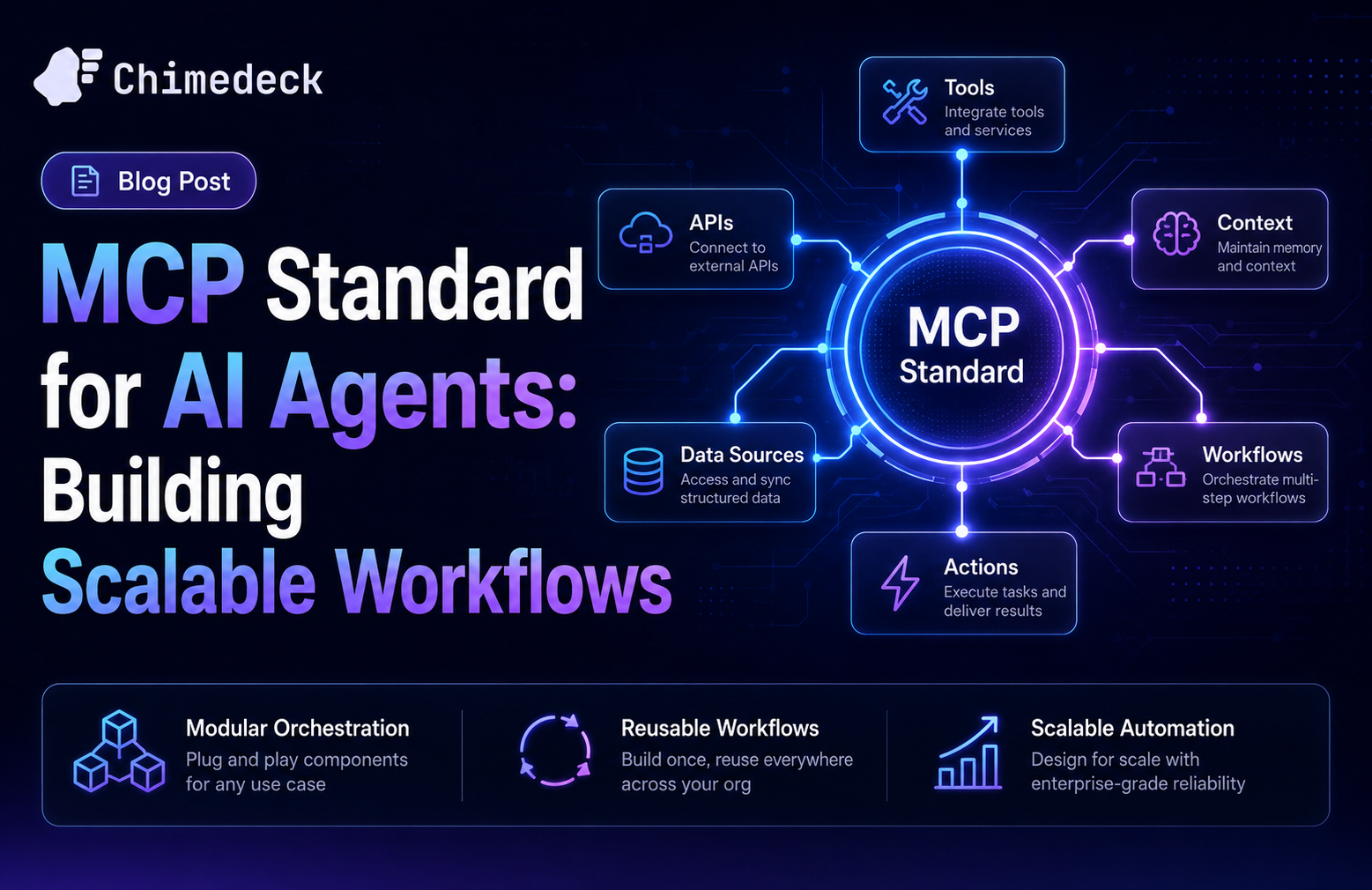
Anthropic designed MCP to solve this by providing a standard protocol instead of requiring developers to build one-off integrations for every data source and tool. Think of it like USB-C for data connectivity. Just as USB-C standardised charging across device types, MCP standardises how AI systems request and receive data from external systems.
=>>> Read More: MCP and Agentic AI: Building Scalable Workflow Systems
How the Model Context Protocol actually works
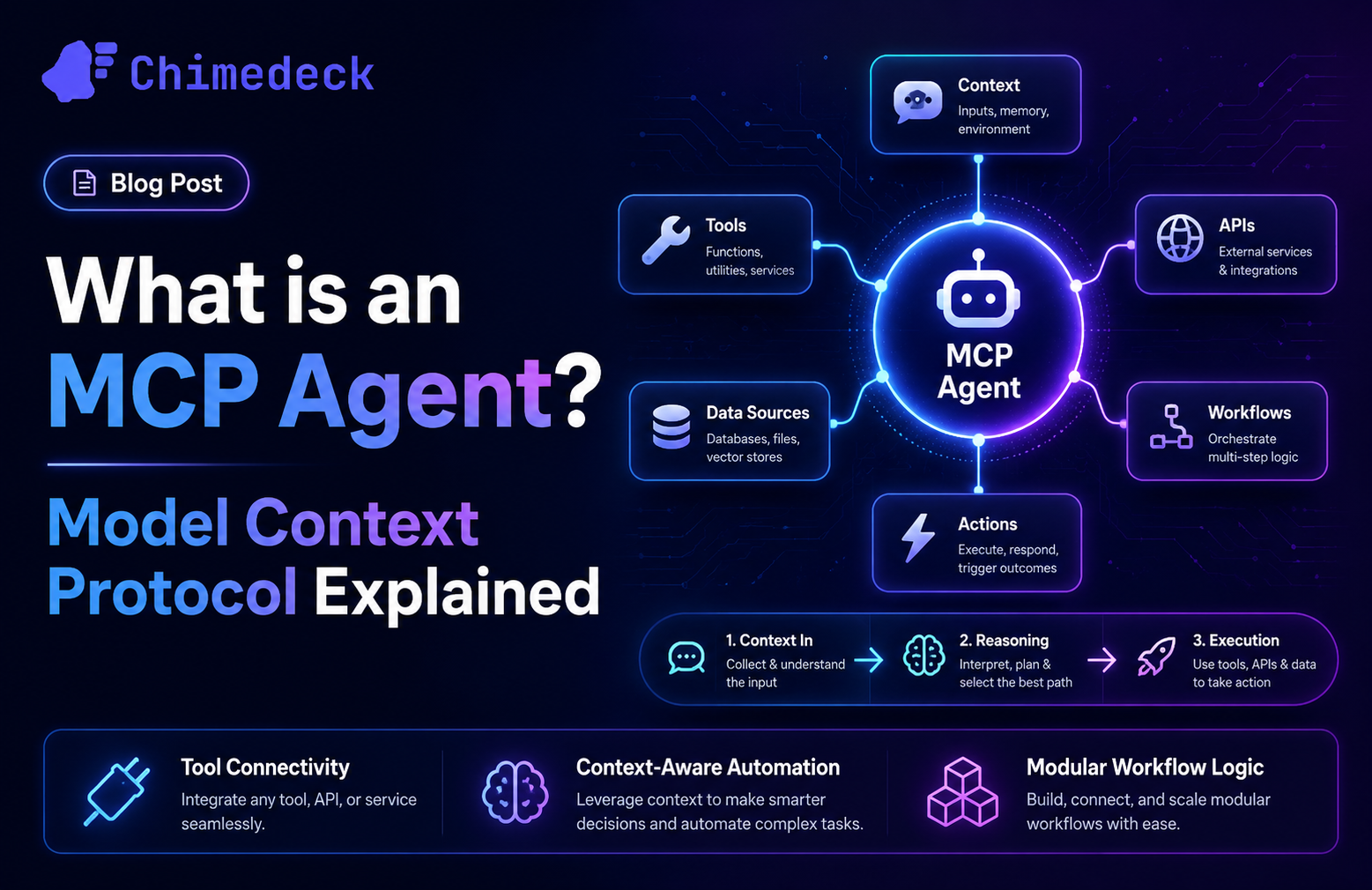
MCP operates on a simple architectural principle: servers expose tools, clients invoke them. An MCP server is software that wraps your data source or application and exposes it as a set of predefined tools. For example, a GitHub MCP server might expose tools like "list repositories," "search issues," and "create pull requests." A Google Drive server exposes "list files," "read document," and "upload file."
An AI agent acts as the MCP client. When you ask an agent to perform a task, the agent examines the tools available to it (the MCP servers you've connected), decides which tool is relevant to your request, and invokes it with the appropriate arguments. The server executes the request against the underlying system and returns structured data back to the agent.
This is different from an agent deciding what to do based solely on its training. The agent isn't generating queries from scratch or trying to write code. Instead, it's selecting from a menu of predefined, secure operations that have been explicitly allowed by whoever set up the MCP server. This distinction is crucial for security and reliability in enterprise settings.
The protocol is open source and backed by Anthropic, but adoption has been remarkably broad. Claude (via the desktop app and web interface), ChatGPT, Visual Studio Code, Cursor, and numerous other AI tools support MCP. Individual companies have released MCP servers for their platforms. GitHub offers one. Slack has announced support. This ecosystem effect means that once you've built an MCP server for your internal system, multiple AI tools can immediately use it.
Why MCP matters more than the hype suggests
The appeal of MCP to vendors is obvious. They get to support every AI tool at once by building a single standard interface. But why should operational teams care?
The real value sits at the intersection of control and scale. MCP lets you grant AI systems access to your data without building bridges yourself. You define the boundaries: which tools the agent can call, what actions they're allowed to take, what data they can read. You're not handing over API credentials to third-party AI companies. Instead, you're running MCP servers in your own infrastructure (or your vendor's infrastructure under your control), which mediate every interaction between the agent and your systems.
This matters because it decouples tool flexibility from security complexity. Without MCP, you had to choose between two bad options: give agents broad access to your systems (risky) or manually integrate each data source one at a time (slow and expensive). MCP lets you do neither. Define your workflow infrastructure once, expose it via MCP, and let multiple AI tools use it safely.
For teams evaluating AI for operations, this is the enabling infrastructure. Your agents are only as useful as the information they can access and the actions they can take. MCP is the mechanism that makes both possible without requiring engineering overhead for every new tool or data source.
MCP in practice: beyond proof of concept
Early adopters have moved beyond experiments. Block, Apollo, and others have integrated MCP into their core operations. Development tools like Zed, Replit, Codeium, and Sourcegraph have adopted it to help AI assistants understand coding context and produce better suggestions. The pattern is consistent: teams use MCP when they want AI to operate within their existing systems, not replace them.
Authentication is handled at the server level. Your MCP server authenticates once to your underlying systems, then enforces least-privilege policies for each tool call the agent makes. This means you can audit every action the agent took, which system it touched, and what data it accessed. For organisations in regulated industries or with strict data governance requirements, this audit trail is non-negotiable.
Security guardrails are defined by the server operator, not the AI vendor. You decide whether an agent can delete records, modify data, or only read it. You define what information can be shared externally. These aren't black-box features of the AI tool. They're explicit rules you configure in your MCP server.

The ecosystem opportunity
What makes MCP significant isn't that it's a clever protocol. It's that it arrived at the moment when organisations were realising that fragmented AI tools require fragmented integrations. As teams move from using individual AI assistants to deploying agents that operate continuously across their operations, they need a way to grant these agents access to existing systems without rebuilding the entire infrastructure underneath.
Task management tools and workflow platforms are particularly well positioned to become MCP servers. Your project management system already knows your tasks, deadlines, dependencies, and team assignments. Exposing this via MCP means any AI agent your team uses can understand your operational context. AI assistants could autonomously identify bottlenecks in your workflows, suggest task reassignments based on capacity, or execute routine project management actions.
The competitive advantage shifts from "which AI tool should we use?" to "how comprehensively can we make our systems visible to AI agents?" Teams with well-structured, accessible operational data will see more value from any AI tool they adopt. This is why workflow platforms with flexible deployment and extensible architecture are becoming foundational infrastructure rather than optional tools.
=>>> Related Post: MCP Agents: Automate Workflows Without Custom Integration
Practical implications for your team
If you're evaluating AI for your operations, ask different questions now. Instead of "which AI tool is smartest?", ask "how can our systems become accessible to whatever AI tools we use?" Instead of "can this AI do what we need?", ask "what infrastructure would we need to build so that this AI could do what we need?" The protocol moves responsibility for enabling AI capabilities from the AI vendor back to your team.
This also reframes the make-versus-buy decision for operational infrastructure. A task management tool that supports MCP servers and flexible deployment becomes more valuable because it becomes a foundation for AI integration. You're not choosing between Trello or a custom system. You're choosing infrastructure that lets you define how AI agents interact with your operations.
For teams beyond a certain size, this distinction matters. You have multiple data sources, complex workflows, and strict governance requirements. You also have multiple AI tools you want to use. MCP makes it possible to have one standardised interface to all of that instead of maintaining integrations for each combination of AI tool and data source.
About Chimedeck
Chimedeck is a next-generation MCP task management platform built for both human teams and AI agents. Unlike traditional project management tools that charge per seat and limit customization, Chimedeck offers flexible deployment options, including cloud-hosted and open-source editions, allowing organizations to adapt workflows without restrictions.
Teams can manage projects through familiar views such as Kanban boards, calendars, task lists, and customizable workflows, while maintaining full control over permissions, collaboration, and operational processes. What makes Chimedeck unique is its AI-native architecture. Through MCP (Model Context Protocol), Chimedeck is designed to seamlessly connect with modern AI agents, enabling them to create, update, prioritize, and execute tasks as part of larger automated workflows.
Whether you're managing a growing team, building agentic systems, or orchestrating complex business processes, Chimedeck provides a unified workspace where humans and AI can collaborate efficiently. Today, Chimedeck is emerging as one of the most comprehensive MCP-powered task management platforms, helping organizations transform task management into intelligent workflow orchestration.