MCP and Agentic AI: Building Scalable Workflow Systems
MCP (Model Context Protocol) powers agentic AI. Discover how it enables scalable, cost-efficient workflows and project management without vendor lock-in or per-seat pricing.
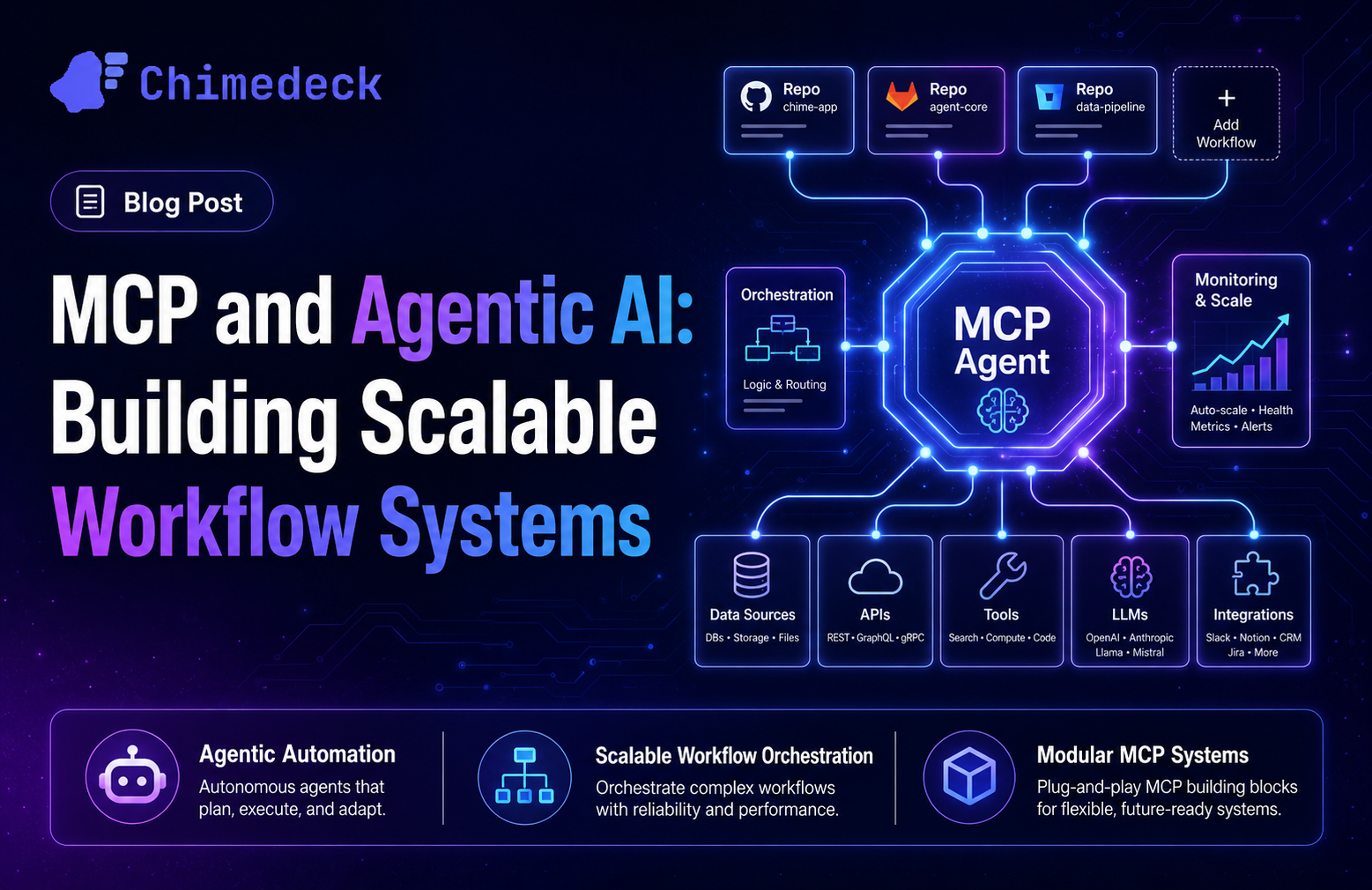
Modern teams face an awkward truth: their most powerful tools sit isolated from each other. Project management systems can't talk to communication platforms. Automation frameworks can't reach internal databases without custom code. And when teams try to layer AI on top of this fragmented stack, they hit a wall of incompatibility and complexity. The Model Context Protocol (MCP) attempts to solve this by creating a standardised way for AI systems to access tools and data. But the implications run deeper than just cleaner integrations. MCP fundamentally changes how organisations can build workflow systems that scale without vendor lock-in or cost friction.

The problem with isolated AI and disconnected tools

AI systems today operate in a vacuum. A language model, no matter how capable, has no native way to access your internal systems, fetch data from your repositories, or trigger actions in your workflows. Teams bridge this gap manually: they build custom API wrappers, Zapier automations, webhook plumbing, and script-based integrations. Each new tool or data source requires its own connector.
This architecture breaks down quickly at scale. A team with five tools might manage ten integration points. A team with fifteen tools faces exponential complexity. And each integration is brittle. When platforms change their APIs, when authentication schemes update, or when you need to swap one tool for another, the whole system feels fragile.
The real cost isn't just technical debt. It's inflexibility. Your workflow system becomes locked to specific tools and vendors. Your automation framework assumes a particular stack. And when you try to introduce AI agents into this environment—tools that need to autonomously access multiple systems—the integration problem becomes paralyzing.
=>>> Related Post: MCP Agent Repos: Building AI Workflows at Scale
What the Model Context Protocol actually does
The Model Context Protocol is Anthropic's answer to this problem. At its core, MCP is a standardised way for applications to expose tools, resources, and context to AI systems. Think of it as a USB-C port for AI: instead of every tool designing its own connector, MCP provides a universal standard that works across any combination of client and server.
The architecture has three components. An MCP host is your application or AI agent—the thing making decisions. An MCP client is the protocol handler within that application. And an MCP server is a process that exposes tools and data through the standardised protocol. A team might run MCP servers for their database, their project management system, their knowledge base, and their internal APIs. The AI agent connects to all of them through a unified interface.
What makes this different from traditional APIs is intent. APIs are designed for applications talking to applications. MCP is specifically designed for AI systems understanding context. An MCP server doesn't just expose endpoints. It exposes tools (functions the agent can call), resources (data the agent can read), and prompts (instructions for using those tools effectively). The protocol is built from the ground up for agentic interaction.
Agentic AI systems need standardised connections
The timing of MCP's release isn't coincidental. Organisations are moving beyond "AI assistance" to "AI automation." Instead of asking a model to generate text, teams are building agents that autonomously manage tasks, coordinate workflows, and make decisions. These systems are only useful if they can actually touch your business systems.
Without standardisation, each agent framework solves this problem differently. LangChain tools work one way. Crew AI frameworks expect another pattern. Custom-built agents roll their own integration layer. The result is fragmentation at the exact moment where standardisation matters most.
MCP changes this equation. A project management agent can use the same MCP connection pattern to access your database, your Slack workspace, and your GitHub repositories. Your content workflow agent can autonomously pull data from multiple sources through identical interfaces. And critically, you're not locked to a single LLM provider. If you want to switch from Claude to another model, your MCP servers work with any compatible client.
Why this matters for open, scalable workflow infrastructure

Here's where MCP intersects with a broader trend in how teams build systems. Organisations are increasingly skeptical of the SaaS model where costs scale with headcount. A tool charging per seat becomes prohibitively expensive as teams grow. And closed platforms create vendor lock-in: switching costs become so high that you're forced to accept price increases and feature decisions you'd never choose independently.
Open source and self-hosted infrastruture offer an alternative, but historically they've required heavy engineering investment. You can run a self-hosted project management system or internal workflow tool, but connecting it to your broader ecosystem demanded custom integration work.
fMCP changes that calculus. Instead of building bespoke connectors, teams write or configure MCP servers for their systems. Those servers become reusable. They can be shared with other teams. They can be swapped out without reimplementing everything downstream. And because MCP is open and standardised, you're not dependent on any single vendor's roadmap or pricing model.
This is particularly powerful for teams building internal systems. An agency managing multiple clients might build a workflow platform tailored to their process. With MCP Agent, that platform can intelligently connect to each client's tools through standardised servers. A product team might create a custom project management system optimised for their shipping process. With MCP, that system can become context-aware, with AI agents autonomously triggering workflows, pulling context, and coordinating across teams without custom glue code.
Building intelligent workflows on your own infrastructure
The practical implication is that teams can now build genuinely sophisticated workflow systems without sacrificing control or flexibility. You're not locked to Trello's feature roadmap or forced to pay Asana's per-seat prices. Instead, you build a system that fits your process. And because MCP standardises how that system talks to the rest of your stack, you can incrementally add intelligence through agentic AI without architectural rewrites.
Consider a concrete scenario. A marketing agency uses a self-hosted project management system (perhaps something like Chimedeck, an open source Trello alternative) for task coordination. They've deployed MCP servers that expose their internal database, their client Slack workspaces, their Google Drive files, and their GitHub repositories. Now they can run an AI agent that reads incoming client requests, automatically creates tasks in the workflow system, pulls relevant background from previous projects, and notifies the right team members. The agent works across all their systems through unified MCP connections. No custom webhooks. No API cobbling. Just standardised context flow.
Or imagine a product team that built a custom workflow system optimised for their shipping cadence. They've never needed Jira's extensive feature set, and they'd rather not pay for enterprise licence costs. With MCP, they can connect that system to their engineering tools, pull real-time data from their monitoring systems, let AI agents autonomously triage tickets based on production impact, and coordinate work across frontend, backend, and infrastructure teams—all because the workflow platform speaks the same standardised language as their other systems.
This model scales because it doesn't require per-seat licensing. An MCP server for your internal tools doesn't care how many agents use it. A workflow platform can have unlimited users without cost scaling with headcount. The cost structure aligns with infrastructure, not personnel.
=>>> Read More: MCP Agents: Automate Workflows Without Custom Integration
MCP as the foundation for next-generation workflow systems
The deeper shift happening here is architectural. For decades, workflow and project management has been domain-specific software. You pick a tool like Trello or Asana, and you build your processes within its constraints. The tool defines your options.
MCP enables a different model: workflow systems as platforms. You build or adopt a system that matches your process. And instead of that system being an isolated island, it becomes a connected node in your broader infrastructure. AI agents can intelligently orchestrate work across it. Your tools can share context. Data flows naturally between systems that were never designed to integrate.
This is why MCP matters for agentic AI specifically. Agents are only useful if they can touch the systems that actually execute work. And they're only cost-effective if you're not rebuilding integrations for every tool combination. MCP solves both problems simultaneously.
The implications for teams are significant. You're no longer forced to choose between simplicity (a lightweight tool like Trello) and power (expensive enterprise systems with custom integrations). You can run a lean, self-hosted system optimised for your workflow and layer intelligence on top through standardised connections. You can switch providers or tools without reimplementing your entire stack. And you can do all of this without per-seat pricing that penalises growth.
Teams that understand this shift early will have a structural advantage. They'll build workflow infrastructure that's flexible, cost-efficient, and AI-ready. They won't be retrofitting integrations into legacy systems five years from now.
Chimedeck: MCP task management platform
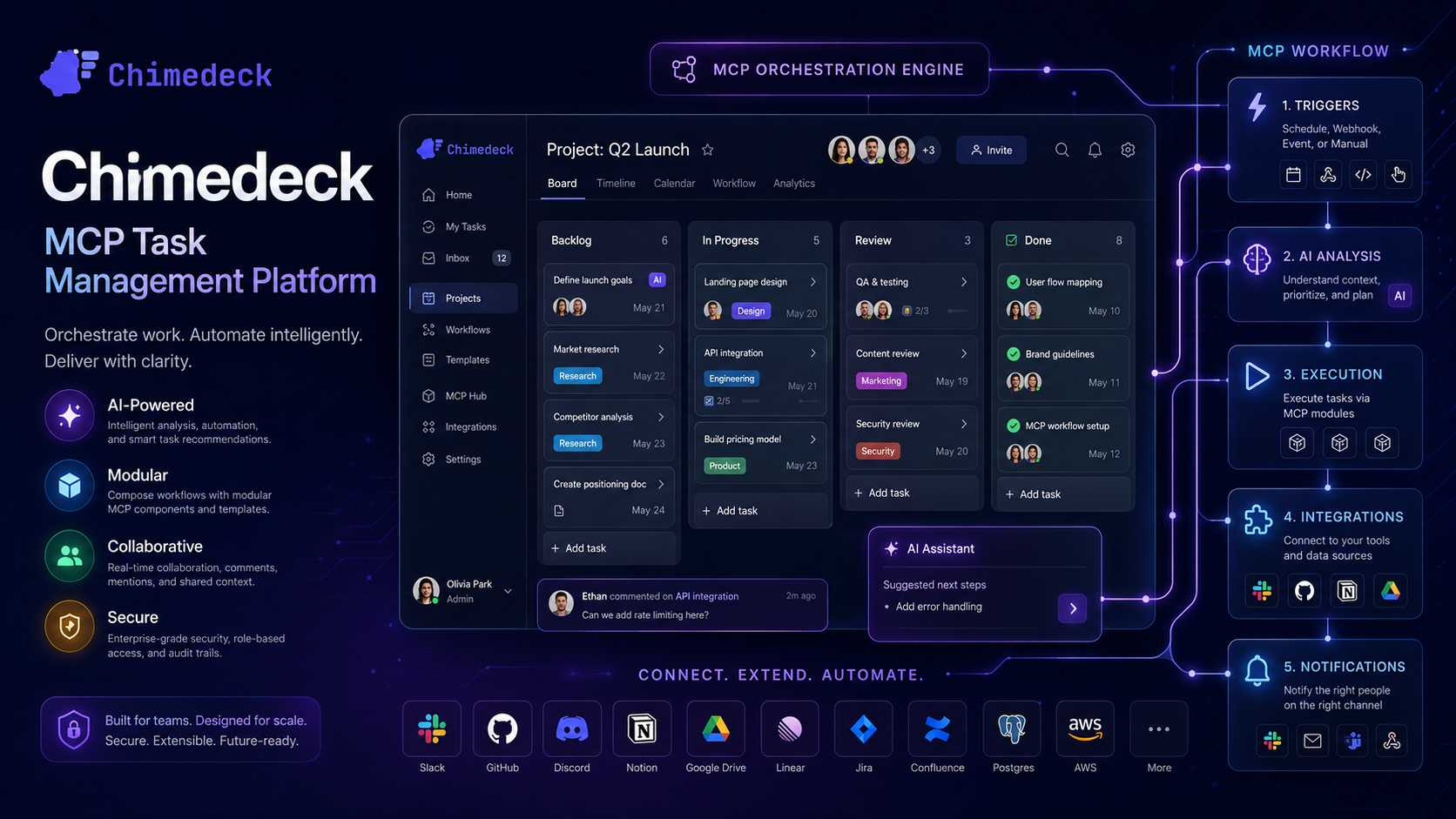
Chimedeck is an open-source project management platform positioned for teams that need scalable, flexible workflow infrastructure without per-seat pricing constraints. Built to work as a self-hosted Trello alternative or cloud-deployed system, Chimedeck combines familiar kanban-style task management with AI-powered workflow automation. The platform's architecture makes it naturally compatible with MCP and agentic AI systems. Teams can expose their Chimedeck workflow as an MCP server, allowing AI agents to autonomously create tasks, update status, and coordinate work across projects. This positions Chimedeck as foundational infrastructure for organisations building intelligent task management tools that adapt to their process rather than forcing teams to adapt to a vendor's constraints.
FAQs
1. What is MCP in Agentic AI?
MCP, or Model Context Protocol, is a framework that helps AI agents connect with external tools, systems, data sources, and workflows in a more structured way. In Agentic AI, MCP acts like a bridge between the AI agent and the operational environment it needs to work in. Instead of building custom integrations for every tool, teams can use MCP to create more modular and scalable connections.
2. How does Agentic AI improve workflow automation?
Agentic AI improves workflow automation by allowing AI systems to plan, decide, execute, and adapt based on context. Traditional automation usually follows fixed rules, while agentic systems can interpret goals, select the right tools, trigger actions, and respond to changing conditions. This makes workflows more flexible, especially for complex business processes that involve multiple tools, teams, or decision points.
3. Why is MCP important for scalable workflow systems?
MCP is important because scalable workflow systems need consistent, reusable, and secure ways to connect agents with tools and data. Without a protocol-based approach, each new integration can become a custom engineering task. MCP helps reduce integration complexity, standardize communication between agents and systems, and make it easier to expand workflows across departments, applications, and use cases.
4. What are examples of MCP and Agentic AI workflows?
Examples include AI agents that automatically triage tasks, summarize project updates, assign work based on context, monitor blockers, generate reports, sync data between tools, or trigger follow-up actions across project management, CRM, documentation, and communication platforms. In a task management environment like Chimedeck, MCP-powered agents can help coordinate workflows across boards, repositories, team updates, and automation rules.
5. Is MCP only useful for technical teams?
No. While MCP is highly valuable for engineering and AI development teams, its impact extends to operations, marketing, customer success, product management, and enterprise workflow automation. Any team that relies on multiple tools, repetitive processes, and cross-functional collaboration can benefit from MCP-based agentic workflows because they reduce manual coordination and make automation easier to scale.