MCP Agent Repos: Building AI Workflows at Scale
Learn how to orchestrate MCP agent repositories with workflow systems for coordinated team automation without per-seat pricing constraints.
Teams building AI-driven workflows increasingly encounter the same problem: MCP agent repositories solve how to connect systems, but they don't solve how to orchestrate work across people. A Model Context Protocol (MCP) agent repo gives developers access to powerful tools and external APIs, yet when multiple team members rely on these agents to execute real business processes, coordination breaks down. The mcp-agent repo becomes a technical foundation without an operational framework.
This gap between technical capability and team coordination is where many organizations hit a wall. They deploy MCP agents successfully in isolation, but scaling that to a functioning workflow across a distributed team requires something beyond what agent frameworks provide: task visibility, progress tracking, workflow routing, and the ability to pause, redirect, or modify work in motion. Go with Chimedeck now!!!

Understanding the MCP Agent Repository Landscape
An mcp-agent repo is fundamentally a set of patterns for building agents that leverage the Model Context Protocol. Rather than embedding all capabilities inside an agent, MCP lets agents dynamically access external tools and APIs. This enables modular, composable agents that are easier to maintain and scale than monolithic systems.
But technical elegance masks an operational reality. An agent can successfully call a Slack API, update a database, or trigger a process. What it cannot do is coordinate across multiple agents, handle human decision points, or provide visibility into what's happening. Once MCP agents start executing real business work, the absence of workflow management becomes a critical gap.

The Challenge: Orchestrating AI Agents Across Teams
A marketing team deploys MCP agents to automate content workflows: research, drafting, scheduling. Each agent works well in isolation. But in practice, humans need to review outputs before proceeding. Complex projects require agents working in sequence with approval gates between stages. None of these orchestration requirements are solved by the mcp-agent repo itself.
Without a coordination layer, there's no visibility into progress, no easy way to pause work, and no shared workspace for humans and AI to coordinate. Teams typically end up building custom workarounds: polling dashboards, maintaining spreadsheets, sending updates manually. These quickly become fragile as complexity grows, and the friction multiplies as teams scale automation across more agents.
=>>> Read More: MCP Agents: Automate Workflows Without Custom Integration
When MCP Agents Replace Traditional Workflow Tools
Some teams mistakenly believe that deploying an mcp-agent repo eliminates the need for a workflow tool. The answer reveals a fundamental distinction: an MCP agent executes work, while a workflow system coordinates it. An open source workflow tool like Chimedeck manages choreography, approval gates, and dependencies. An mcp-agent repo handles execution.
Agents and workflows are complementary. Agents excel at deterministic work execution. Workflow systems excel at routing, sequencing, and coordination. Together they solve both problems. Teams that try to replace workflow tools with agents alone end up rebuilding notification systems, audit logs, permission models, and dependency management from scratch, which quickly exceeds the cost of maintaining a proper platform.

Building a Workflow System Around MCP Agent Repositories
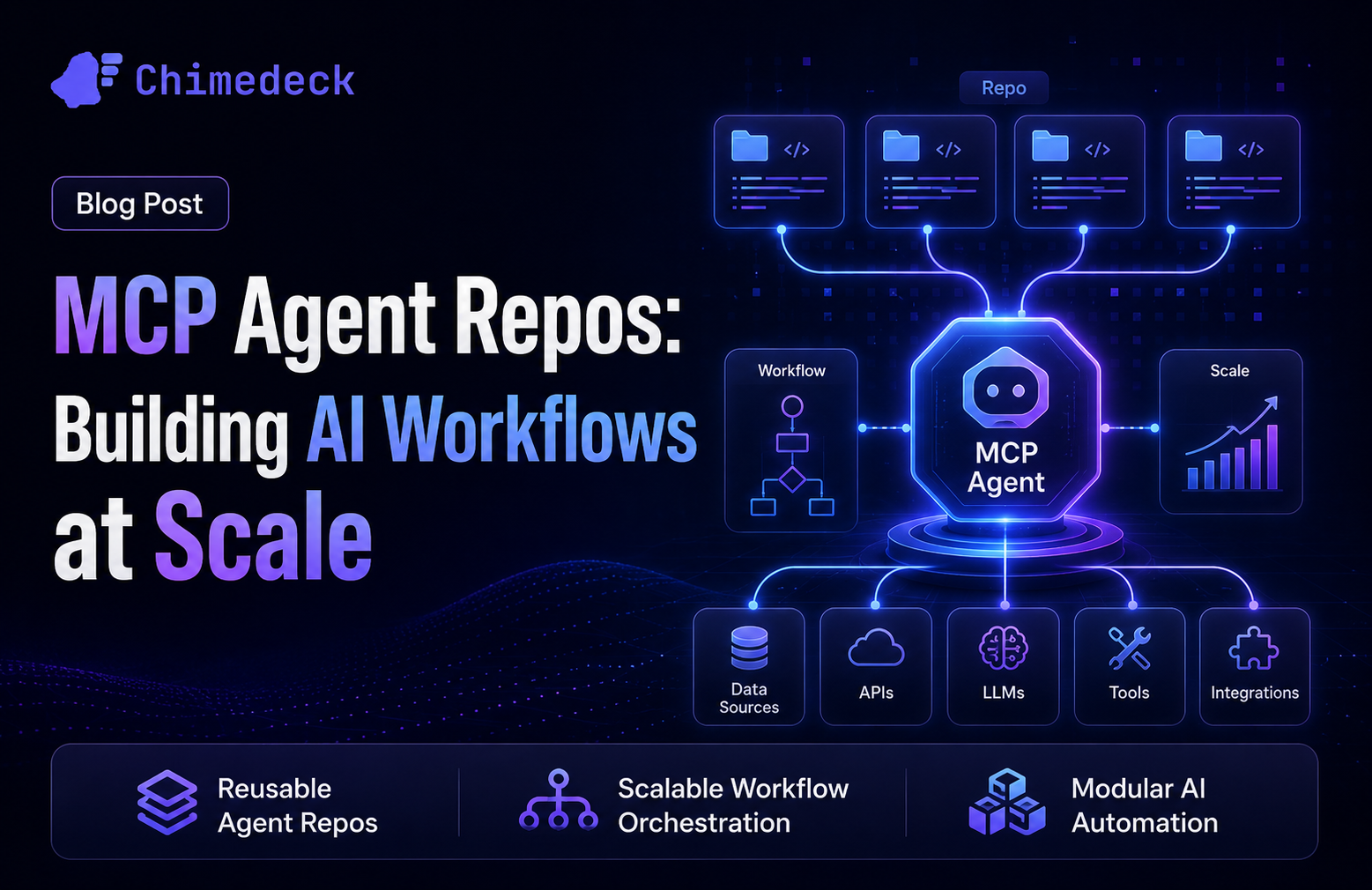
Organizations that scale MCP agents successfully maintain a separation of concerns: agents handle execution, workflow platforms handle coordination. The workflow system acts as the orchestrator, deciding which agents to trigger, in what sequence, with what inputs, and what happens when they succeed or fail.
For teams with multiple mcp-agent repos in production, this pattern becomes essential. The workflow system becomes the central nervous system, routing work to the right agents, managing state, handling retries, and providing teams with visibility into operational progress. Workflows become observable, and human oversight remains practical because the system captures decision points explicitly.
Modern workflow tools need to support AI-native patterns natively. They need to handle agent callbacks, asynchronous execution, dynamic routing based on agent outputs, and integration with LLM reasoning. Traditional workflow systems aren't designed for this and become a bottleneck rather than an enabler.

Integrating MCP Agents Into Your Workflow System
The practical pattern is straightforward: your workflow system orchestrates agent execution. When a workflow reaches a task requiring agent execution, the system triggers the appropriate mcp-agent repo with necessary inputs. The agent returns results, the workflow evaluates success or failure, and routes work accordingly. This might mean an approval gate for human review or conditional routing based on agent output. The workflow system maintains control over the overall process.
For organizations running multiple mcp-agent repos, a central workflow platform prevents fragmentation. Each agent can be independently versioned and deployed. The workflow system remains the single source of truth for how work moves through the organization. This architecture also enables practical operational improvements: monitoring agent performance across all repos through a single dashboard, implementing audit trails, setting up alerts for error thresholds, and measuring work distribution across agents.
=>>> Related Post: MCP and Agentic AI: Building Scalable Workflow Systems
Choosing the Right Platform for AI-Driven Workflows
When evaluating workflow tools for mcp-agent repos, cost structure matters first. Traditional per-seat pricing breaks when agents run significant volume. A platform with unlimited users and flexible deployment scales without artificial friction. Flexibility matters too: some teams need cloud hosting, others need self-hosted systems for data control or compliance. The right platform supports both.
AI-readiness is critical. The workflow platform should understand agent patterns natively. It should support asynchronous callbacks from agents, handle dynamic branching based on agent outputs, and integrate with external tools your agents access. An open source alternative to tools like Trello offers full customization for agent integrations and avoids vendor lock-in, which becomes important as teams scale AI automation across operations.
Chimedeck - MCP Task Management Platform
About Chimedeck
Chimedeck is a MCP task management and workflow orchestration platform built specifically for the era of AI agents.
With native MCP (Model Context Protocol) support, Chimedeck allows AI agents to interact directly with business workflows, making it possible to automate task creation, work assignment, status updates, prioritization, and cross-functional coordination. Rather than treating AI as an external add-on, Chimedeck enables agents to become active participants in day-to-day operations.
The platform combines advanced workflow management with the flexibility organizations need to scale. Teams can manage work through Kanban boards, calendars, custom workflows, permissions, and collaborative workspaces, while choosing either a cloud-hosted or open-source deployment model.
Whether you're managing internal operations, software development, customer projects, or autonomous AI systems, Chimedeck provides a unified environment where humans and AI agents can work together seamlessly. For businesses adopting agentic workflows, Chimedeck offers one of the most complete MCP-enabled task management solutions available today.