Trello for Marketing Teams: Beyond the Kanban Board
How marketing teams use Trello, where it stops scaling on pricing, views and automation, and when an alternative like Chimedeck makes more sense.
Marketing teams spend an enormous amount of energy managing the logistics of their work. Content calendars, campaign launches, design reviews, social media scheduling, asset approvals. Each of these demands coordination across multiple people, tight deadlines, and clear visibility into who is doing what and when.
For years, Trello has been the default answer. It's simple, visual, and easy to teach a new team member. But as teams grow, the initial appeal of Trello starts to expose some uncomfortable structural limitations. Cost scales with headcount. Feature depth remains constant. Complex workflows get forced into a kanban metaphor that breaks down under pressure. By the time a marketing team realises they've outgrown the tool, they are already deeply embedded in the workflows and integrations that made it feel essential.
The real question is not whether Trello is good. It is whether Trello is right for your specific team, at your specific stage, with your specific constraints.
Why Trello became the marketing standard
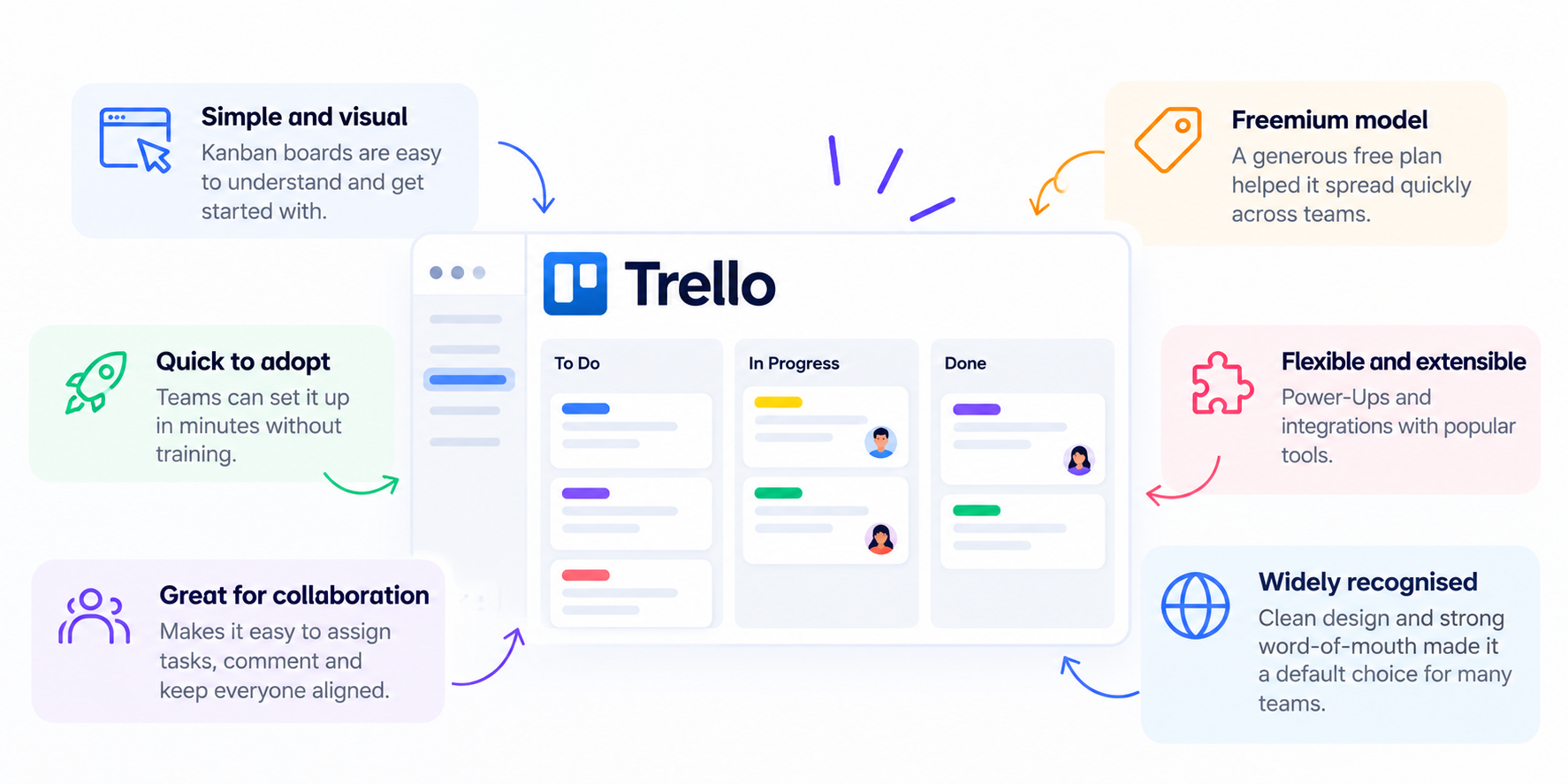
Trello's dominance in the marketing toolspace is not accidental. The product is genuinely well-designed for a particular problem: visualising serial workflows at team scale without learning a project management methodology.
A marketing team can set up a Trello board in minutes. Cards move from "To Do" to "In Progress" to "Done". Stakeholders immediately understand the state of every project. Bottlenecks become visually obvious. Deadlines are set, owners assigned, and conversation happens in context.
For small teams or teams new to structured workflow management, this simplicity is a feature, not a limitation. There is no learning curve. There are no unused dashboard views. The tool gets out of the way and lets the team focus on work.
Trello also solved the integration problem early. Power-Ups connect to Google Drive, Slack, Figma, MailChimp, and dozens of other tools that marketing teams already use. That integration advantage was substantial five years ago. It remains meaningful today, though the gap has closed considerably.
How marketing teams get the most out of Trello
Before deciding Trello is the problem, check whether the team is using what it already offers. Trello's own templates, such as Editorial Calendar, Go To Market Strategy, and an annual email marketing calendar, give content and campaign work a ready-made structure. Calendar view (on Premium) shows publish dates and campaign deadlines at a glance, which is often exactly what a content calendar needs.
Butler automation can move cards when a due date passes, assign a reviewer when a card enters an approval list, or add a checklist to every new campaign card. Power-Ups for Figma, Google Drive, and Mailchimp keep design files, briefs, and email campaigns attached to the card they belong to. For a small team running one or two workflows, this setup is often enough. The limits described below start to matter as headcount and cross-team dependencies grow.
The structural costs of growth
The trouble emerges when the team grows beyond 8 or 10 people. Not because Trello stops working, but because the economics and feature set start to pinch in ways that compound.
First, there is the cost structure. Trello's pricing is per-user per-month. At launch, this feels reasonable: five people on Standard (about $5 per user per month, billed annually) cost roughly $25 a month. But Premium, the plan that unlocks Timeline, Calendar, and Table views plus unlimited automation runs, costs about $10 per user per month billed annually or $12.50 billed monthly. A 30-person marketing team plus a dozen freelancers and client reviewers on Premium pays roughly $420 to $525 every month, and the bill grows with each new collaborator.
Unlike some SaaS tools that offer flat team tiers, Trello's model assumes that every person who touches a card is a paying user. Contractors, freelancers, stakeholders from other departments, client team members in an agency context. All of them accumulate cost.
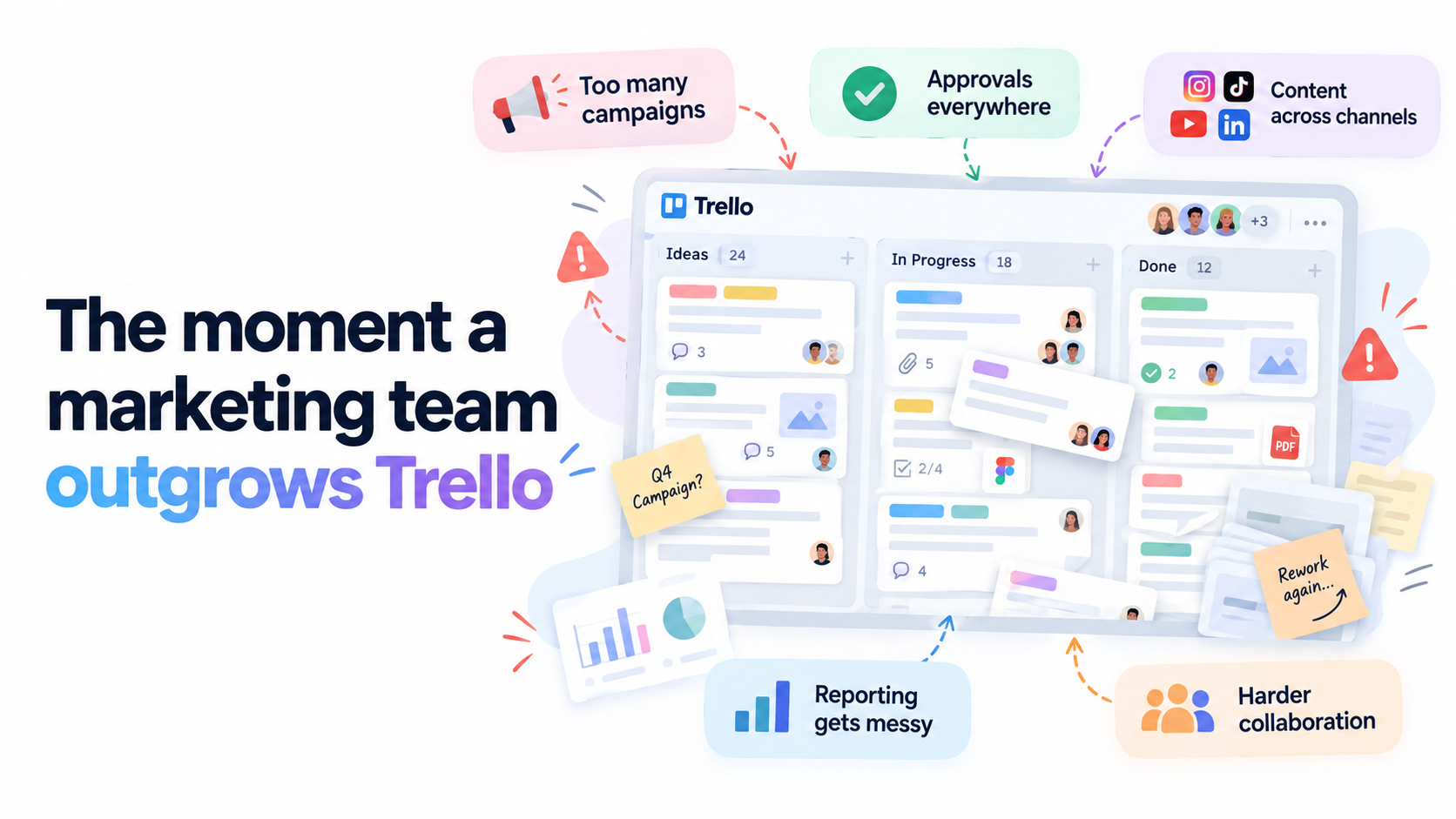
The second cost is structural. Trello is optimized for single-workflow visualisation. A marketing team managing editorial calendars, paid campaigns, design work, and social content simultaneously will often find itself creating multiple boards. Visibility fragmentizes. Context switching increases. Work falls through cracks between boards.
Some teams attempt to solve this with a single master board, but complexity grows nonlinearly. Filtering, labeling, and searching become burdensome. Reports and bulk operations remain limited. Built-in Butler automation covers common rules, but run limits on the Free and Standard plans and cross-tool workflows often push teams toward services like Zapier.
The third cost is operational. Trello's board view, while intuitive for small teams, becomes insufficient as work becomes more interdependent. A content piece might need approval from three different stakeholders. A campaign might depend on external vendor deliverables. Timeline and Calendar views are locked to Premium, and even there Trello offers limited support for task dependencies, resource allocation, and capacity planning. Many teams eventually resort to parallel spreadsheets or external planning tools.
None of these issues make Trello "bad". They make it unsuitable for teams whose complexity exceeds what a kanban board can represent.
The moment a marketing team outgrows Trello
The decision to move away from Trello is rarely sudden. Teams usually recognize it by noticing one or more of these signals.
The per-user cost reaches a threshold where it feels indefensible. At that point, the team starts asking whether they could use the savings for a different class of tool altogether.
Workflow complexity exceeds kanban representation. Approvals involve multiple stakeholders. Dependencies are bidirectional. Resource allocation is a real constraint. A single-track view becomes a liability instead of a virtue.
Integration requirements grow beyond Power-Ups. The team needs custom workflows, API access, or deeper connection to internal systems. They want a platform, not a tool.
Data control becomes important. Some teams need self-hosted infrastructure for compliance, security, or sovereignty reasons. Trello offers no self-hosted option. That non-negotiable requirement eliminates it entirely.
The team needs automation that reaches beyond the board. Trello's Butler handles rules inside Trello well, but connecting campaigns to internal systems or AI agents usually means adding Zapier or custom middleware.
These signals do not point to a universal replacement. Instead, they point to a question: what kind of tool ecosystem makes sense for this specific team?
Beyond Trello: what the alternative landscape offers
When a marketing team decides Trello is no longer the right fit, the range of Trello alternatives for marketing work is genuinely diverse. Each category addresses a different priority.
Asana, Monday.com, and Jira represent the "enterprise project management" category. These tools offer sophisticated workflow automation, timeline views, resource allocation, and deep reporting. They are substantially more expensive than Trello, and the learning curve is steeper. For some teams, that investment is justified. For others, it is overkill.
Notion and Airtable appeal to teams that want extreme flexibility and customisation. You can build almost any workflow in these tools. The trade-off is that you are doing significant configuration work yourself. They are platforms, not out-of-the-box solutions.
Self-hosted open-source boards such as Taiga or Wekan exist, alongside heavier suites like OpenProject, but they typically require hosting and technical maintenance. That becomes a tax on the team unless someone has engineering bandwidth to manage it.
Then there is the category that tries to bridge the gap: tools that combine visual kanban simplicity with the scale, customisation, and cost structure needed by growing teams. This is where Chimedeck sits. It is an open source Trello alternative built on the principle that teams should not be penalised for growth.
Chimedeck's positioning is explicit: unlimited users, flexible deployment (self-hosted or cloud), no per-seat pricing, and AI-powered workflow automation as a native feature. It is designed for teams that have outgrown simple tools but do not want to pay enterprise tool prices or lose the visual simplicity that made Trello easy to adopt in the first place.
Why cost efficiency and control matter at scale
For a growing marketing team, the conversation around tooling often gets framed purely as "features". But the economics and governance model matter just as much.
A free Trello alternative that is actually sustainable makes a real difference. When your tool cost does not scale with headcount, you can invest in better people, better content, better campaigns. When you own your infrastructure or deploy it on your own terms, you are not at the mercy of a SaaS vendor's pricing changes or feature decisions.
For agencies specifically, this becomes critical. An agency serving 10 clients with mixed team compositions faces cascading Trello costs if they create separate boards and user accounts per client. With a unified, unlimited-user platform, the economics invert. A single instance serves all clients with no per-head penalty.
For in-house teams subject to procurement rules, security requirements, or data residency constraints, self-hosted infrastructure is not a luxury. It is a requirement. Trello cannot meet it. An open source workflow platform can.
These are not edge cases. They are increasingly the default for teams operating at anything beyond the smallest scale.
Evaluating a smarter workflow tool
When you are assessing whether your team has genuinely outgrown Trello, or whether a different tool might serve you better, focus on these concrete dimensions.
What is the actual cost of your current tool, including all users, at your expected team size in 12 months? Compare that to the cost model of alternatives. If the gap is material, that is a legitimate decision signal.
What workflows does Trello force you to manage outside the tool? If your team maintains separate spreadsheets for capacity planning, timeline dependencies, or resource allocation, that is a sign the tool is not expressing your actual work structure. A different tool might be.
What are your compliance, security, or data control requirements? If any of them require self-hosting or on-premise deployment, Trello is not an option. If you need a platform that supports that requirement, Chimedeck and other open-source alternatives become relevant.
How much integration customisation do you actually need? Simple Power-Up connections are sufficient for most teams. But if you need deep API access, custom automations tied to your internal systems, or the ability to extend the platform, you need a tool built for that level of extension.
What is the learning overhead? Trello is easy to teach. More complex tools are not. If your team is large enough to absorb learning overhead, the feature gains may justify it. If you are mostly small teams or rapid onboarding is a constraint, simplicity remains valuable.
These questions guide you toward the right answer for your context, not toward a universally "best" tool.
The case for open, scalable workflow infrastructure
The long arc of marketing operations is moving toward integrated systems rather than fragmented tool stacks. This is not speculation. Teams are literally running that experiment right now.
A marketing team using Trello, Google Sheets, Zapier, Slack, and Asana to coordinate work is really using six tools with multiple hand-offs and data silos between them. That works at small scale. It becomes increasingly painful as the team grows or complexity increases.
A single integrated platform that is unlimited by user count, open to customisation, and capable of automating operations end-to-end addresses a real problem. And it does so at a cost structure that actually makes sense for growing teams.
Chimedeck is built on this thesis. It offers the simplicity and visual clarity that made Trello succeed, the scalability and flexibility that teams eventually demand, and the cost model that stops penalising teams for growth.
Because pricing does not depend on headcount, adding freelancers or client reviewers does not change the bill. Because it keeps a board-first interface, teams coming from Trello can adopt it without a long implementation. Self-hosting still needs someone to own updates and backups, so teams without technical capacity can start with the cloud option instead.
Getting started: from evaluation to implementation
If your marketing team is in the position of evaluating alternatives to Trello, the path forward is straightforward.
Map your current workflows and constraints. Where are the bottlenecks? Where are you maintaining parallel tools? What are your non-negotiable requirements around cost, control, or integration?
Run a time-boxed pilot with a different tool on a single workflow or team. Do not attempt a big-bang migration. Use a real use case to understand whether the new tool actually solves the problems you think it will solve.
Involve the team in the evaluation. The people using the tool daily will spot friction that leadership misses.
Calculate the true cost of change, including migration effort, training, and lost productivity. Compare that to the cost savings from a different tool model.
Once you have evidence, make a deliberate decision. If Trello is genuinely serving your team well, do not change for change's sake. But if cost, complexity, or control are becoming real constraints, exploring alternatives is worth the effort.
For many growing marketing teams, that exploration leads to a realisation: they need a tool that is as simple as Trello but as capable and cost-efficient as the best open-source and self-hosted platforms. That is where Chimedeck enters the conversation.
Chimedeck: MCP task management platform
Chimedeck is an open-source workflow and task management platform designed for teams that need the simplicity of Trello with the flexibility and cost efficiency of self-hosted infrastructure. Built on unlimited-user pricing, AI-powered automation, and full data control, Chimedeck serves agencies, growing startups, and enterprises that want scalable project management without vendor lock-in or escalating per-seat costs. It combines kanban-style boards with advanced workflow capabilities, making it an ideal choice for marketing teams managing complex, multi-stakeholder operations at any scale.