Trello Disadvantages: Why Teams Outgrow Trello
Discover the key disadvantages of Trello including per-seat pricing, limited customisation, scaling challenges, and poor data control. Learn when to move beyond Trello.

Trello has become synonymous with task management for many teams. Its visual kanban approach is intuitive, and getting started takes minutes rather than days. However, as teams grow or workflows become more complex, the limitations of Trello become increasingly apparent. Understanding these constraints is critical for teams evaluating whether to stay on Trello or explore alternatives that scale better with operational demands.
The disadvantages of Trello extend beyond surface-level friction. Many teams discover that what initially felt like a perfectly adequate tool starts to buckle under real-world use cases such as complex dependencies, scaled team collaboration, and cost scaling at headcount.
Per-Seat Pricing That Grows With Your Team
One of the most immediate drawbacks of Trello is its per-seat pricing model. Unlike some alternatives, Trello charges for each user added to a workspace. For small teams this is manageable, but for agencies, enterprises, or rapidly scaling startups, this becomes a cost control problem.
When your company grows from 10 to 50 to 100 team members, Trello's monthly bill doesn't just grow proportionally to value—it compounds. Teams often find themselves restricting who can access boards or consolidating work into fewer accounts to manage costs. This creates friction: contractors can't see what they need, stakeholders are locked out, and knowledge silos form.
By comparison, many open-source and self-hosted solutions charge based on infrastructure costs, not headcount. Chimedeck explicitly ditches per-seat pricing, allowing unlimited users by design. This fundamentally changes how teams can organise work and collaborate without constantly weighing cost implications.
Limited Workflow Customisation
Trello's strength is also its constraint: it enforces a simple kanban model. Columns, cards, and some basic fields. This works well for straightforward workflows, but real-world operations are often more nuanced.
Teams working on complex projects need conditional logic, multi-step approval flows, and sophisticated field types. Trello doesn't support these natively. You can add Power-Ups, but you're stacking third-party tools on top of Trello, fragmenting your data and creating integration overhead. When your actual process requires branching logic or multi-stage approval pipelines, Trello forces you to either oversimplify your workflow or implement workarounds.
This is a significant trello disadvantage for teams managing anything beyond simple task lists. Agencies tracking client work through approval stages, product teams managing feature releases with dependency tracking, or operations teams orchestrating multi-functional handoffs all run into this ceiling quickly.
Task management tools built on more flexible foundations allow you to design workflows that match your actual process, not the other way around.
Scaling Collaboration Across Teams
Trello's board-centric structure makes it difficult to manage work across multiple interconnected teams. If one team's tasks depend on another team's deliverables, you're either creating duplicate boards or building external tracking spreadsheets to manage dependencies.
Visibility also becomes a problem. Each board lives in isolation. There's no built-in way to see cross-functional dependencies, resource allocation, or how one team's work affects timelines elsewhere. Large organisations end up running parallel systems: Trello for day-to-day tasks and separate tools (or spreadsheets) for roadmaps, capacity planning, and cross-team coordination.
This fragmentation is especially painful for distributed teams. Time zone differences, async communication requirements, and the need for historical context all demand a unified system where information flows across team boundaries naturally, not through manual synchronisation.
Limited Automation and Intelligence
Trello automation is mostly trigger-action: if a card moves, do X. For more sophisticated automation you're again reaching for Power-Ups or external tools like Zapier. Building intelligent workflows that respond to context, automatically surface bottlenecks, or intelligently prioritise work based on dependencies requires engineering time or vendor lock-in to a third-party automation layer.
AI-native workflow tools have begun embedding intelligence directly into the system. Automatic task suggestions, dependency detection, and adaptive prioritisation reduce manual overhead. Trello's architecture doesn't support this kind of embedded intelligence—it's designed to be simple, not smart.
For teams looking to reduce manual coordination overhead and move towards AI-augmented operations, Trello leaves significant value on the table.
Data Control and Vendor Lock-in
Trello data lives on Atlassian's servers. You can export your data, but the system isn't designed for easy portability. If your operational requirements change, moving away from Trello is non-trivial. You're dependent on Atlassian's product roadmap, pricing decisions, and infrastructure reliability.
For teams in regulated industries or organisations with strict data residency requirements, Trello's SaaS-only model is a dealbreaker. You can't self-host it, can't integrate it directly with your internal infrastructure, and can't guarantee data sovereignty.
Open-source and self-hosted alternatives remove this dependency. Chimedeck and similar free Trello alternatives can be deployed on your own infrastructure, giving your team full control over data and system availability.
When to Move Beyond Trello
The disadvantages of Trello are most acute when your team or organisation crosses certain thresholds: more than 10-15 active users, workflows requiring more than three columns, cross-functional dependencies, or regulatory requirements around data control.
The cost argument alone often justifies migration for agencies or enterprises. A 50-person team on Trello's Business Class plan pays roughly £400 per month. A open source trello alternative running on modest infrastructure costs a fraction of that, with unlimited users baked in.
Beyond cost, the flexibility argument is compelling. When your team's workflow can't be squeezed into Trello's model without heavy external tooling, you're paying the cost of Trello plus the cost of workarounds. At that point, moving to a more flexible system becomes economically and operationally sensible.
Chimedeck: MCP Task Management Platform
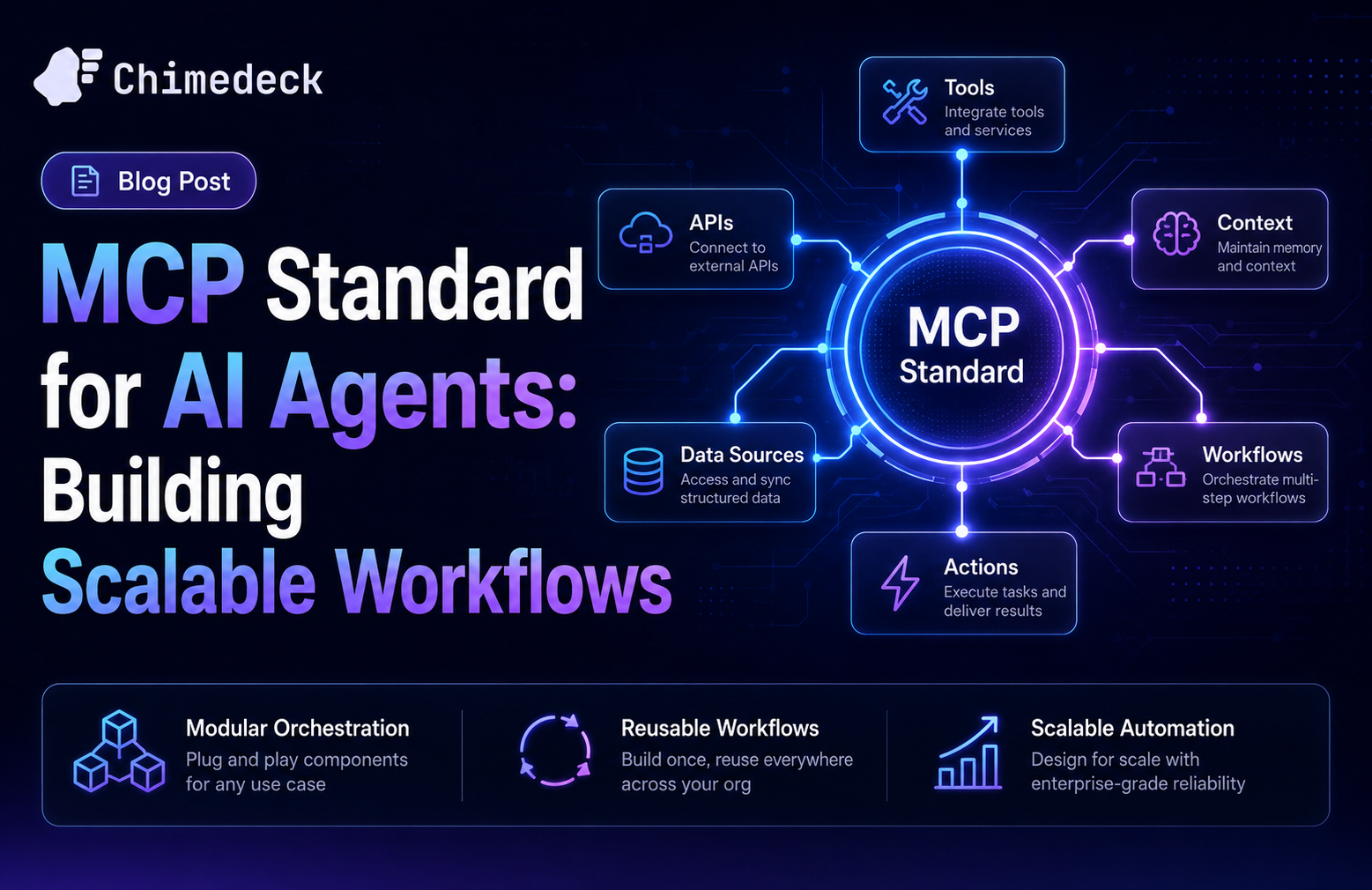
Chimedeck is an open-source workflow and task management system built to address the structural limitations of tools like Trello. Designed for teams that outgrow simple kanban systems, Chimedeck combines unlimited users, flexible self-hosted deployment, and AI-powered workflows into a scalable platform. Unlike Trello, there's no per-seat pricing friction, no workflow rigidity, and full data control. It's built for teams that need their tools to evolve with them as they scale.