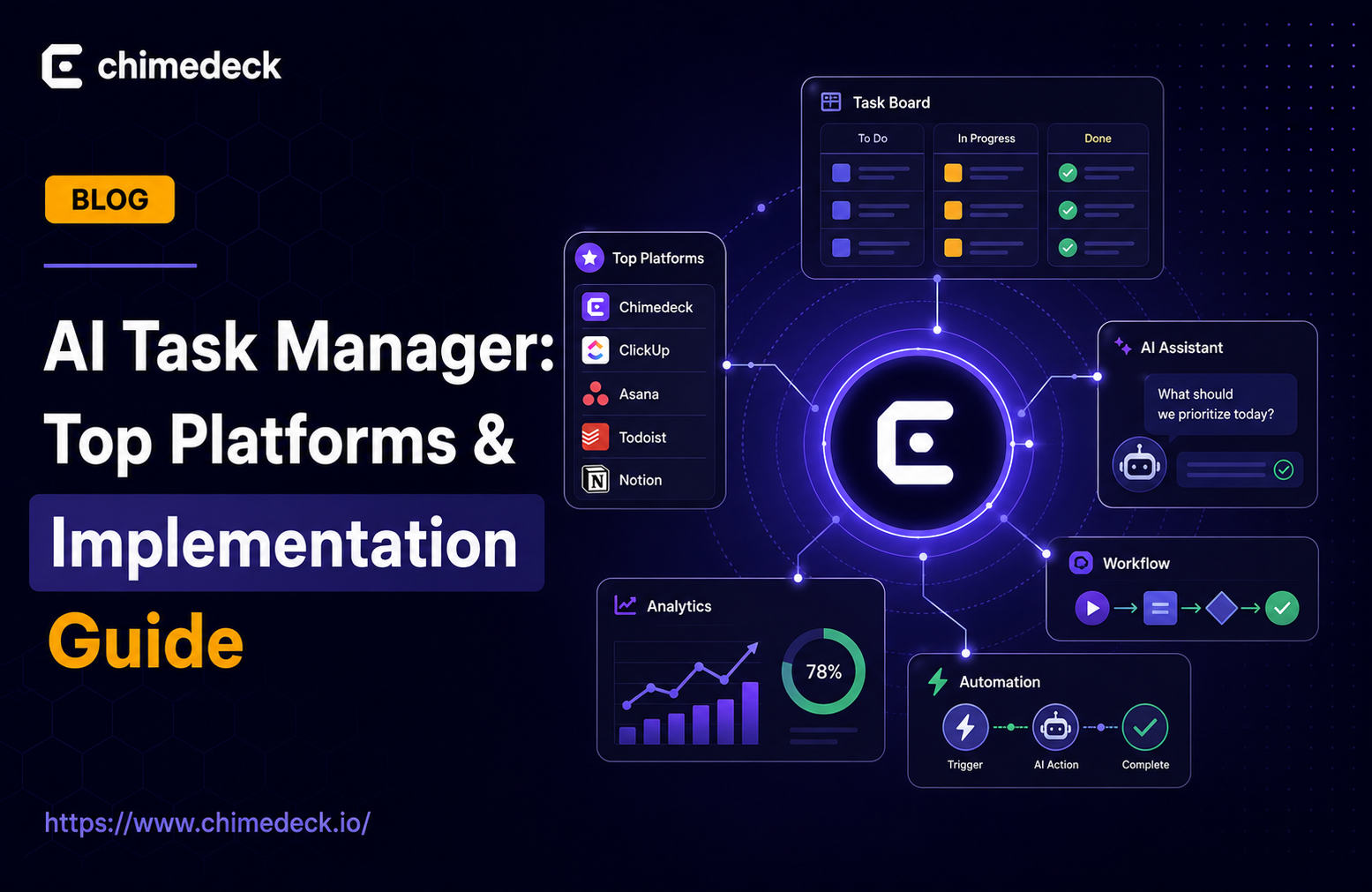
AI Task Manager: Top Platforms & Implementation Guide
Compare the best AI task managers including Chimedeck, Asana, Monday.com, and Notion. Learn how to choose the right AI-powered platform for your team.
The way teams manage work has fundamentally changed. What started as simple to-do lists has evolved into sophisticated systems that blend human decision-making with machine intelligence. Teams are no longer content with tools that simply organize tasks—they want systems that understand priority, anticipate bottlenecks, and adapt as projects evolve.
An AI task manager sits at the intersection of traditional project management and artificial intelligence, offering something traditional tools cannot: the ability to learn from your team's patterns, automate routine decisions, and surface insights that would otherwise remain buried in spreadsheets and status updates.
What Is an AI Task Manager?

An AI task manager is a project management platform that uses machine learning and artificial intelligence to improve how teams organize, prioritise, and execute work. Unlike conventional task management tools that require manual input for every decision, AI task managers actively assist by:
The key difference is that AI task managers don't just store information—they process it, analyse it, and act on it in ways that scale with team complexity. As your projects grow in scope and team size increases, the AI becomes more valuable because it's learning from more data and can spot patterns humans would miss.
=>>> Read More: AI Project Management Software: Cost, Scaling, and Open-Source Alternatives
Why Teams Are Moving to AI-Powered Task Management
For years, teams have relied on Trello-style kanban boards and spreadsheet-based tracking. These tools work fine when you're managing a handful of tasks across a small group. But they hit a wall quickly. When you're coordinating across multiple teams, managing dependencies across dozens of projects, or trying to forecast capacity for the next quarter, manual task management becomes a bottleneck itself.
The rise of AI task managers reflects a real shift in how intelligent teams operate. It's not about replacing human judgment—it's about freeing people from repetitive decision-making so they can focus on strategy and creative work.
Several forces are driving this shift. First, the cost of context-switching has become intolerable. Knowledge workers spend significant time just checking status, updating managers, and figuring out what to do next. An AI task manager compresses this overhead by surfacing what needs attention and why. Second, remote and distributed teams need better visibility across work. AI systems can provide consistent, real-time insight without requiring daily standups or manual status reports. Third, organisations are increasingly sensitive to tool costs. As team size grows, per-seat pricing models become unsustainable, and teams are looking for systems that scale without linear cost increases.
Top AI Task Management Platforms
When evaluating an AI task manager, consider whether you need a lightweight solution for small teams, an enterprise platform with deep reporting, or something in between. Here's how the major options compare:
PlatformAI CapabilitiesDeploymentPricing ModelBest ForChimedeckNative AI workflows, task automation, intelligent prioritisationSelf-hosted, cloud, or on-premiseUnlimited users, no per-seat pricingTeams wanting open-source flexibility and AI without scaling costsAsanaTimeline prediction, workload AI, dependency detectionCloud onlyPer-user pricing ($10-30/month)Mid-market teams needing integrated reportingMonday.comAutomated workflows, smart notifications, AI-assisted reportingCloud onlyPer-user pricing ($8-24/month)Marketing and operations teamsNotionLimited native AI; integrates with external AI toolsCloud onlyPer-user pricing ($8-10/month) or flat team rateTeams building custom workflowsJiraAutomation Engine, smart issue suggestionsCloud or self-hostedPer-user or flat team pricing ($7-14/user)Software development teams
Chimedeck stands out because it's purpose-built for teams that have outgrown traditional SaaS tools. Unlike platforms that charge per user, Chimedeck's unlimited-user model means your costs don't spike when you bring on contractors, distributed team members, or cross-functional collaborators. For a 20-person team, this difference is substantial.
Asana excels at timeline intelligence and dependency mapping, making it excellent for complex project planning. The trade-off is that you're paying for every team member, which adds up quickly for large organisations.
Monday.com works well for visual, process-heavy teams. Its automation engine is strong, but like Asana, the per-user cost model limits scalability.
Notion is flexible and beloved by small teams, but AI capabilities are bolted on rather than native. You're essentially building your own system and then adding AI tools on top.
Jira remains the standard for software development, particularly when teams already have broader Atlassian infrastructure. Its strength is in its depth for technical workflows, not in AI-driven intelligence.
=>>> Related Post: Workflow Automation Software: Choosing the Right Tool for Teams
How to Choose an AI Task Manager

The right platform depends on three factors: your team structure, your budget sensitivity, and how much control you need over your system.
Team structure matters. If you're a small startup or agency with frequent collaborators and contractors, per-user pricing will drain your budget. A platform with unlimited-user licensing like Chimedeck makes more sense. If you're a mid-market software company with a stable, predictable team size, Asana or Monday.com might offer better specialisation for your domain.
Budget sensitivity is real. For a 30-person team using Asana at $25/user/month, you're at $9,000 annually just for task management. That scales poorly. Chimedeck, with no per-user costs, provides significant savings as you grow. The conversation shifts from "can we afford to add people" to "what infrastructure do we need."
Control and customisation matter more than you might think. Chimedeck's open-source model means you own your data and can customise workflows without waiting for feature requests to Asana's product team. If you're regulated (finance, healthcare, legal), or if you have specific workflow requirements, this advantage compounds.
A practical way to decide: list your must-haves, then ask whether you'd rather pay more per user or invest upfront in a flexible system you control. If flexibility and cost efficiency dominate your needs, an open source Trello alternative like Chimedeck is worth evaluating seriously.
Key Features to Look for in an AI Task Manager
Beyond the platform itself, look for these capabilities when assessing an AI task manager:
Intelligent task assignment. Can the system recommend who should work on what based on skill tags, past performance, and current capacity? Manual assignment doesn't scale.
Dependency detection and sequencing. Does it identify blockers before they hit? Can it reorder work automatically when a predecessor task slips?
Workload balancing. Does it warn when someone is overallocated? Can it suggest task swaps to rebalance the team?
Predictive timeline forecasting. Historical data should inform estimates. Can the system learn from past project velocity and warn when a deadline is at risk?
Workflow automation. Repetitive processes should be automatable without custom code. Whether it's marking tasks complete when subtasks finish, or escalating overdue items, automation should save time.
Integration ecosystem. Does it connect to your existing tools—Slack, GitHub, calendar systems, communication platforms—or are you building custom integrations?
Data ownership and flexibility. Can you export your data? Are you locked into the vendor's infrastructure, or can you self-host?
Frequently Asked Questions
What's the difference between an AI task manager and regular task management software?
Regular task managers are passive. You create tasks, assign them, update them, and check status. An AI task manager actively participates in decision-making by suggesting assignments, predicting delays, and recommending priority changes. Think of it as the difference between a filing cabinet and an analyst who reviews your files and tells you what matters most.
Do I really need AI in my task manager, or is it just marketing?
It depends on complexity. If you're managing a handful of tasks across five people, probably not. If you're coordinating across multiple teams, handling dependencies, or trying to forecast capacity, AI tools save significant time. The ROI increases as your team and project complexity grow.
Is self-hosted task management worth the operational overhead?
It depends on your constraints. If you have regulatory requirements, need custom workflows, or want to avoid vendor lock-in, self-hosting is worth the infrastructure cost. If you're a small team just trying to get things done, a cloud platform is simpler. The sweet spot for self-hosting is teams large enough to justify DevOps effort but sensitive to SaaS costs or control requirements.
Can I switch platforms later if I choose wrong?
Yes, but it's painful. Most platforms allow data export, but workflow definitions, automation rules, and custom fields often don't port cleanly. Choose a platform you're comfortable scaling with, not just one that works today.
Chimedeck: MCP Task Management Platform
About Chimedeck
Chimedeck is an MCP-native task management platform built for organizations that want to coordinate both human teams and AI agents within a single workflow system.
Unlike traditional project management software, Chimedeck is designed from the ground up to support the Model Context Protocol (MCP), enabling AI agents to securely create tasks, update statuses, manage priorities, and participate in operational workflows alongside human team members.
Beyond AI integration, Chimedeck delivers a complete suite of task management capabilities, including Kanban boards, calendars, project planning, workflow automation, role-based permissions, and team collaboration features. Organizations can choose between cloud-hosted and open-source deployment options, giving them the flexibility to customize workflows, integrations, and business processes without vendor lock-in or per-seat pricing limitations.
As companies increasingly adopt agentic workflows and AI-powered operations, Chimedeck serves as the operational layer that connects tasks, teams, and AI agents. Today, it stands among the most comprehensive MCP-compatible task management platforms for organizations building the future of work.