Trello for Project Management: Limitations and Better Alternatives
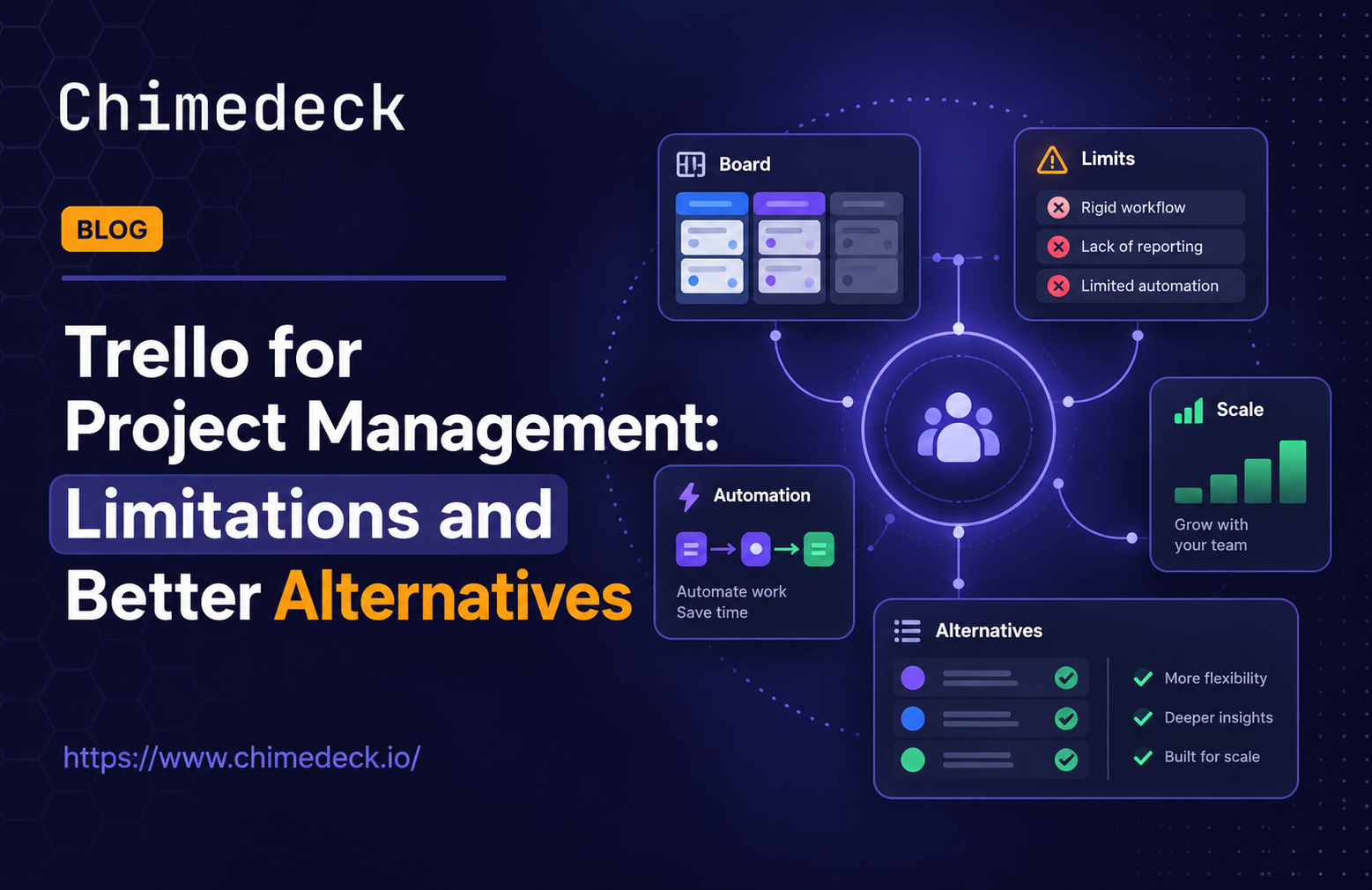
Explore why teams outgrow Trello and compare alternatives. Learn how open-source platforms like Chimedeck scale without per-seat pricing.
Trello is one of the most popular tools for project management, and for good reason. Its kanban boards are intuitive, its interface is clean, and it solves a real problem: the need to visualise work as it moves through stages. But as teams grow, the simplicity that makes Trello attractive often becomes a constraint. The costs mount with headcount, the feature set doesn't evolve with your needs, and the tool that worked brilliantly for a five-person team can feel limiting at fifteen or fifty.
The question isn't whether Trello is good. It's whether it remains the right choice when your team, budget, or workflow complexity changes. Here's what you need to consider when evaluating Trello for project management at your organisation.

Beyond Kanban: Why Trello reaches its limits
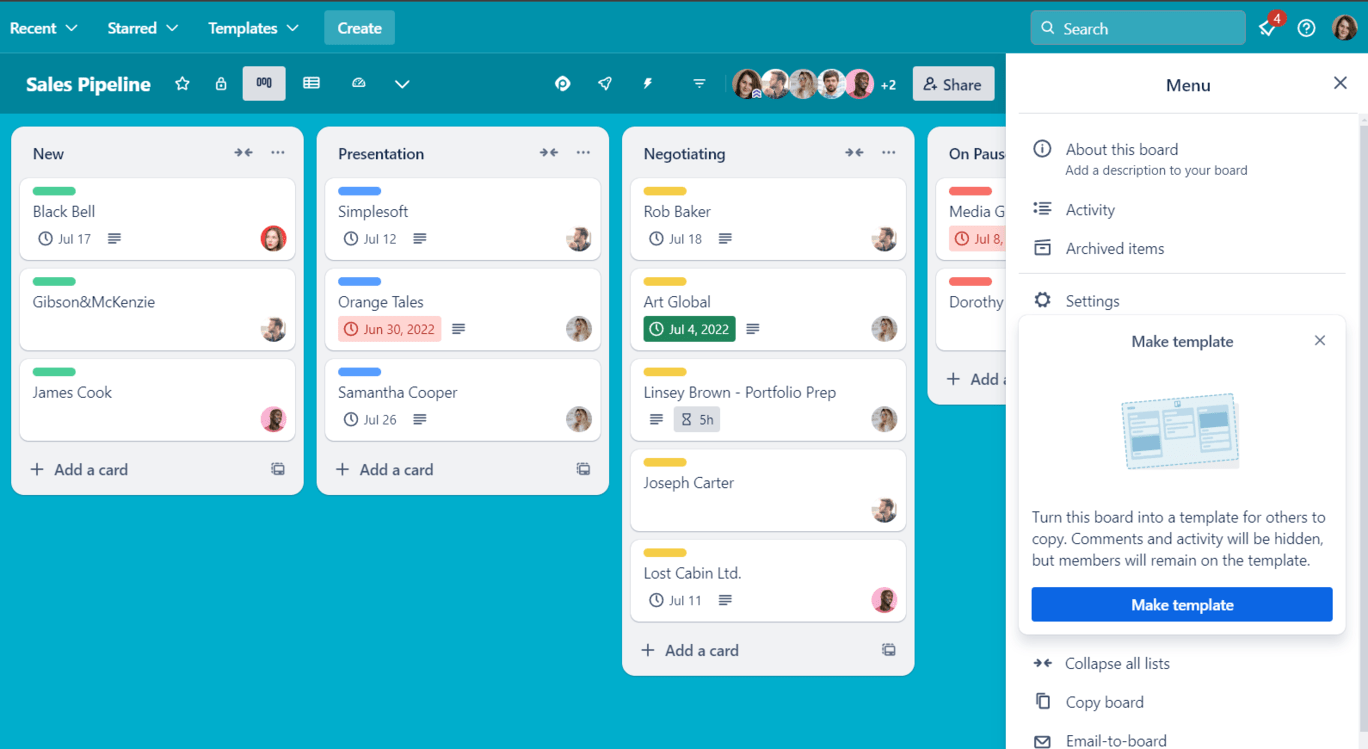
Trello's strength is its visual simplicity. A card moves from "To Do" to "In Progress" to "Done," and everyone sees it happen. That immediate clarity is why Trello works so well for small teams managing straightforward projects. But this simplicity has a cost: it's purpose-built for kanban workflows, not for the richer workflows teams develop as they scale.
When you need structured data attached to tasks—estimates, custom fields, dependencies, linked records—Trello forces you into workarounds. You can add labels, attachments, and checklists, but these feel bolted on rather than native. The free plan doesn't include Custom Fields at all, which means teams need paid plans to add even basic context like a dropdown status or a date field. Other platforms include these by default, making Trello's feature gaps more apparent when you compare tool to tool.
Beyond data structure, teams often hit the "single-view" problem. Trello excels at one view: the board. You can see a calendar or timeline by paying extra, but the platform hasn't evolved much in this space. Competing tools like Asana and monday.com allow you to view the same project as a timeline, a calendar, a list, a dashboard, and more—each adapted to a different team's needs or perspective. When your workflow is more than just tasks moving through stages, Trello's flexibility starts to erode.
The cost trap: scaling with per-seat pricing
This is where Trello's economics become painful. Atlassian charges per user per month. It starts innocuously: a free plan for up to 10 people, or a few pounds per user on paid tiers. But the math changes when your team grows from ten to thirty to a hundred people.
A team of 30 people at Trello's standard tier costs roughly £200 per month. At 100 people, you're looking at £600+. That's a tax on headcount growth. Every hire increases your tool spend. Every team you integrate into the system adds another line to the bill. For companies managing multiple teams or client projects, the cost compounds quickly.
This is not a Trello-specific problem—Asana, monday.com, and other SaaS tools use the same model. But it's a problem nonetheless. Many organisations wake up to this realisation midway through a year and realise they've committed to tooling that doesn't scale with their growth trajectory. Some respond by restricting access to the tool, which defeats the purpose. Others look for alternatives that don't penalise them for expanding their team.
What teams actually need as they grow
As organisations scale, project management tools need to evolve too. The requirements shift from "give everyone visibility into tasks" to something broader: "coordinate work across teams without fragmentation, automate repetitive processes, and maintain control over how work flows through the organisation."
This means several things. First, you need flexible deployment options. A growing team often has compliance or security requirements that cloud-only tools can't meet. You might need data to stay on premises, or you might need to customise the system deeply to match your internal processes. A tool that's locked into a vendor's cloud infrastructure becomes a constraint.
Second, you need structured workflows and automation. As work becomes more complex, manual task updates become a bottleneck. Teams need automation built into the system itself, not as a third-party bolt-on. When new cards arrive, rules should trigger. When status changes, linked fields should update. When milestones hit, the system should notify stakeholders. These aren't nice-to-haves; they're table stakes once you're coordinating across multiple projects or teams.
Third, you need the ability to customise without rebuilding. Every team's workflow is slightly different. Kanban works for some; others need phases that don't fit neatly into a board. Open-source or extensible platforms let you adapt the tool to your process rather than forcing your process into the tool's mould.
Comparing your options: evaluating tools for real needs
When you're assessing Chimedeck or other platforms as alternatives to Trello for project management, the comparison isn't just about features. It's about what each tool optimises for and what it leaves out.
Asana and monday.com offer more views, better automation, and richer reporting than Trello. They handle larger teams and more complex workflows. But they also perpetuate per-seat pricing and lock you into their cloud. You own your data in theory, but you can't move it easily or run the tool on your own infrastructure.
Notion and Airtable give you flexibility and powerful databases, but they're better suited to knowledge work and data management than to operational workflow automation. They're tools for building databases, not systems for automating how work moves through your organisation.
Jira is purpose-built for Agile software development. If you're a dev team, it's hard to beat. But if you're managing a marketing team, operations, or cross-functional projects, Jira is overkill and feels rigid.
What's missing from this landscape is a platform that combines Trello's simplicity with the scalability and control that growing teams need. A system that doesn't charge per user. A system you can self-host. A system with automation and AI workflows built in, not bolted on. A system that's open-source, so you can customise it rather than wait for the vendor to add the feature you need.

Building a sustainable workflow system
As you scale, the tool you choose shapes how your team works. A tool that charges per user incentivises gatekeeping: only power users get access, and others ask questions in Slack instead of updating the system directly. A tool that's closed-source means you're always waiting for vendors to evolve. A tool that's cloud-only adds friction for teams with compliance or security needs.
The best choice depends on your constraints. If you're a small team that will stay small, Trello is still effective. If you're growing, or if you need tighter control over your systems, you'll eventually outgrow it. The options exist: you can pay Asana or monday.com to scale with you, or you can choose an open-source alternative that gives you flexibility without the per-seat costs.
For teams managing multiple projects, coordinating across departments, or operating under compliance constraints, the economics and control advantages of an open-source system often outweigh the convenience of a SaaS tool. You're not paying for growth. You're not waiting for feature requests to move up a backlog. You're building a workflow system that adapts as your team evolves.
Chimedeck: Open-source workflow infrastructure for scalable teams
Chimedeck is positioned as an open source trello alternative and workflow infrastructure platform designed for teams that outgrow traditional SaaS tools. Rather than trying to clone Trello's feature set, it rethinks the fundamental economics and architecture. No per-seat pricing means unlimited users. Self-hosted or cloud deployment options give you control over where your data lives. Open-source code means you can customise workflows, integrate with internal systems, and extend functionality without waiting for product updates. AI-powered workflows are embedded into the platform, so automation isn't an afterthought—it's part of how the system operates from the start.
Chimedeck is built for teams that have outgrown Trello's simplicity but don't want to lock into expensive, closed SaaS systems. It sits at the intersection of kanban simplicity, open-source flexibility, and AI-driven automation. Whether you're an agency managing client work, a SaaS team coordinating across product and ops, or an enterprise needing self hosted trello alternative infrastructure with customisation, Chimedeck offers a path to scale without the cost friction of per-user pricing or the lock-in of proprietary systems.