Best Trello Alternative for Agencies in 2026
Find the right Trello alternative for your agency. Compare pricing, features, and workflows that scale without per-seat costs. Explore open-source options like Chimedeck.
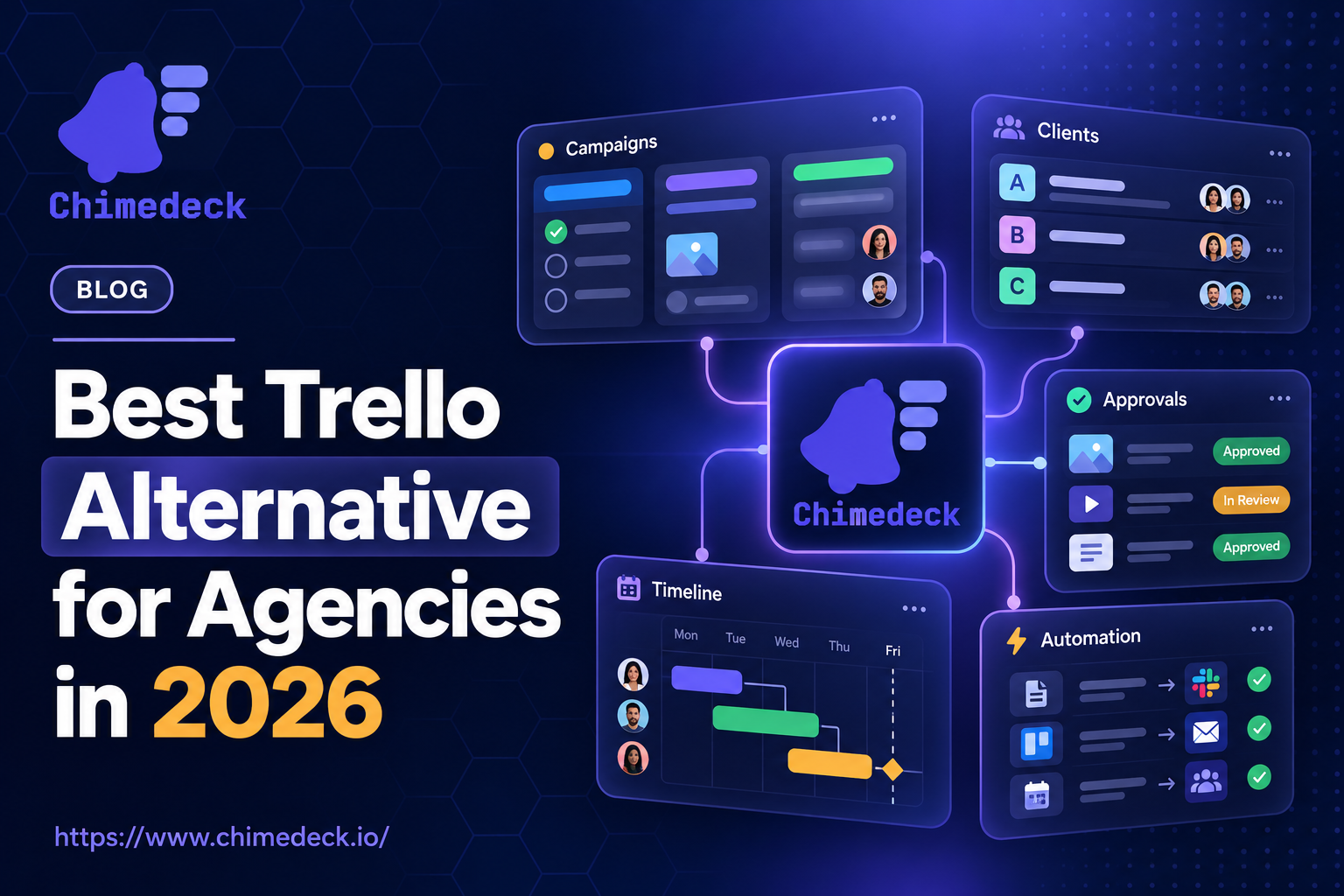
Agencies operate in a different universe from typical SaaS teams. You're juggling multiple clients, shifting team compositions, and workflows that change month to month depending on project scope. What works for a 5-person in-house marketing team breaks immediately when you're coordinating across 20 people working on 8 concurrent client projects.
The friction starts with tools like Trello. Simple when you're small, but it compounds fast. Every person you hire adds licensing cost. Every client project adds complexity Trello's Kanban boards can't contain. Every workflow requirement demands a Power-Up you'll eventually outgrow. Agencies need to scale without that cost and complexity drag.
The Economics of Agency Tool Costs
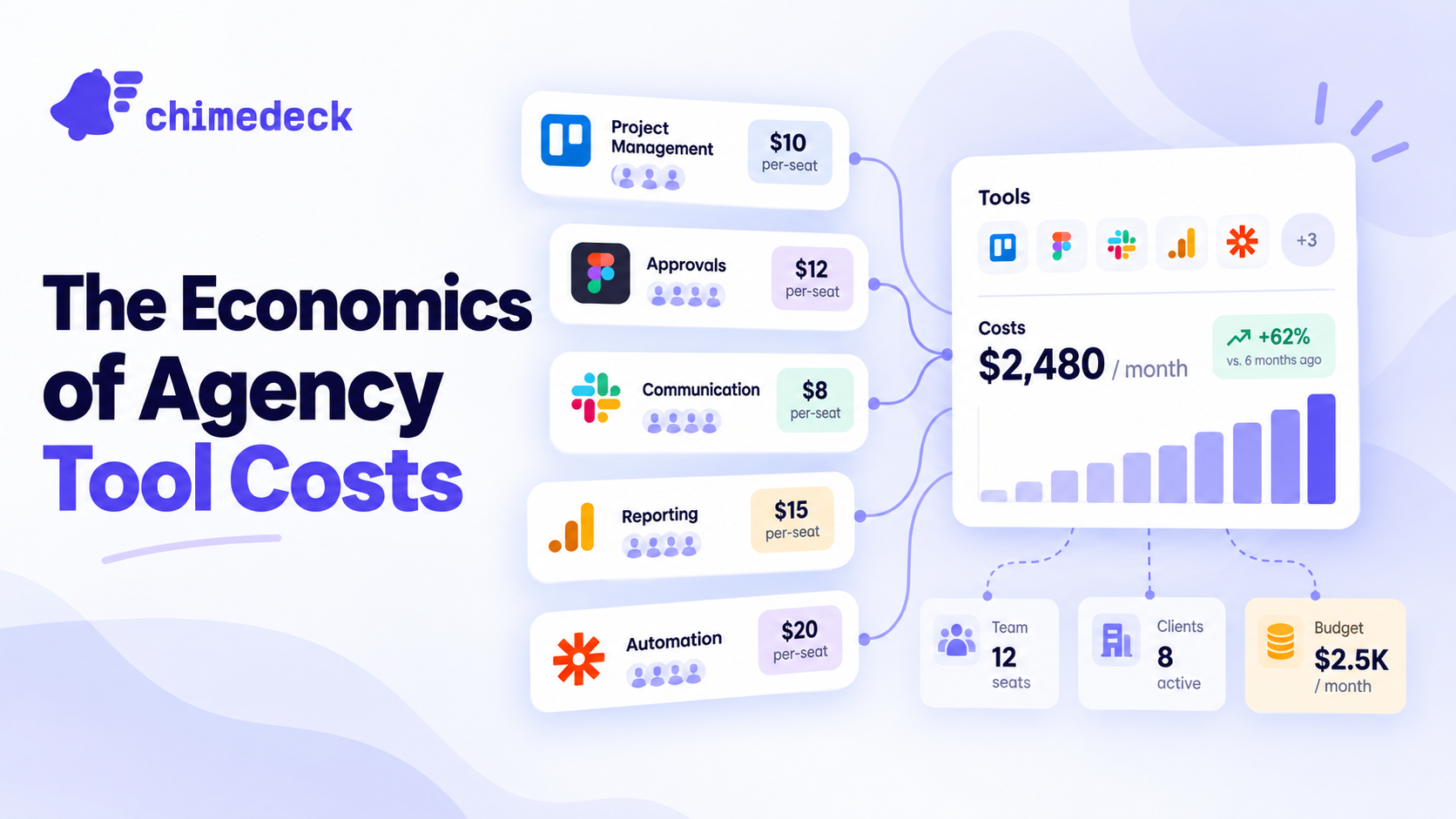
Trello charges by the seat. At $5 per user per month (standard tier), a 10-person agency pays $600 annually. Scale to 20 people managing multiple client streams, and you're at $1,200 a year just for Trello. Add Power-Ups for automation, file storage, or integrations, and your actual spend doubles.
The real problem isn't the absolute number. It's the scaling pattern. Your agency grows. You hire a designer, then a project manager, then contractors for specific clients. Each hire increases your tool costs whether they use the system or not. A 30-person agency paying per-seat across Trello, Slack, project management, and other tools faces compounding friction that forces an uncomfortable choice: limit access to keep costs down, or accept runaway software expenses.
Compare this to what Asana charges ($10.99 per user annually on Starter, $24.99 on Advanced) or Monday.com ($9-19 per user). At 20 people, you're spending between $2,000 and $5,000 yearly on project management alone. At 50 people, the math becomes unsustainable. Open-source alternatives like Chimedeck work differently. They charge infrastructure costs, not headcount. This inversion matters when you're building systems meant to scale.
Why Traditional Tools Fail Agency Workflows
Agencies deal with constraints that typical SaaS teams don't face. Your team isn't static. You hire contractors for specific projects, onboard offshore designers for surge work, and scale up capacity seasonally. Traditional tools assume a fixed roster of seats, billed monthly, whether half the team uses the system or not.
Client work also demands isolation that Trello doesn't provide natively. You can create separate boards for each client, but visibility and permission models stay crude. An account manager needs to see portfolio-level status across all clients without exposing confidential client work across the team. Trello's approach forces workarounds: duplicate boards, external spreadsheets, or manual sync processes.
Workflow complexity scales differently too. In-house product teams repeat the same sprint structure. Agencies handle different project types simultaneously: design sprints with tight dailies, long-tail retainer work with looser cadence, and fixed-scope delivery projects with hard deadlines. A tool built for one workflow type creates friction when teams need flexibility. Trello's Kanban is great for simple workflows. Most agencies need more: task dependencies, time tracking, resource allocation, and client billing integration.
Comparing Trello Alternatives for Agencies
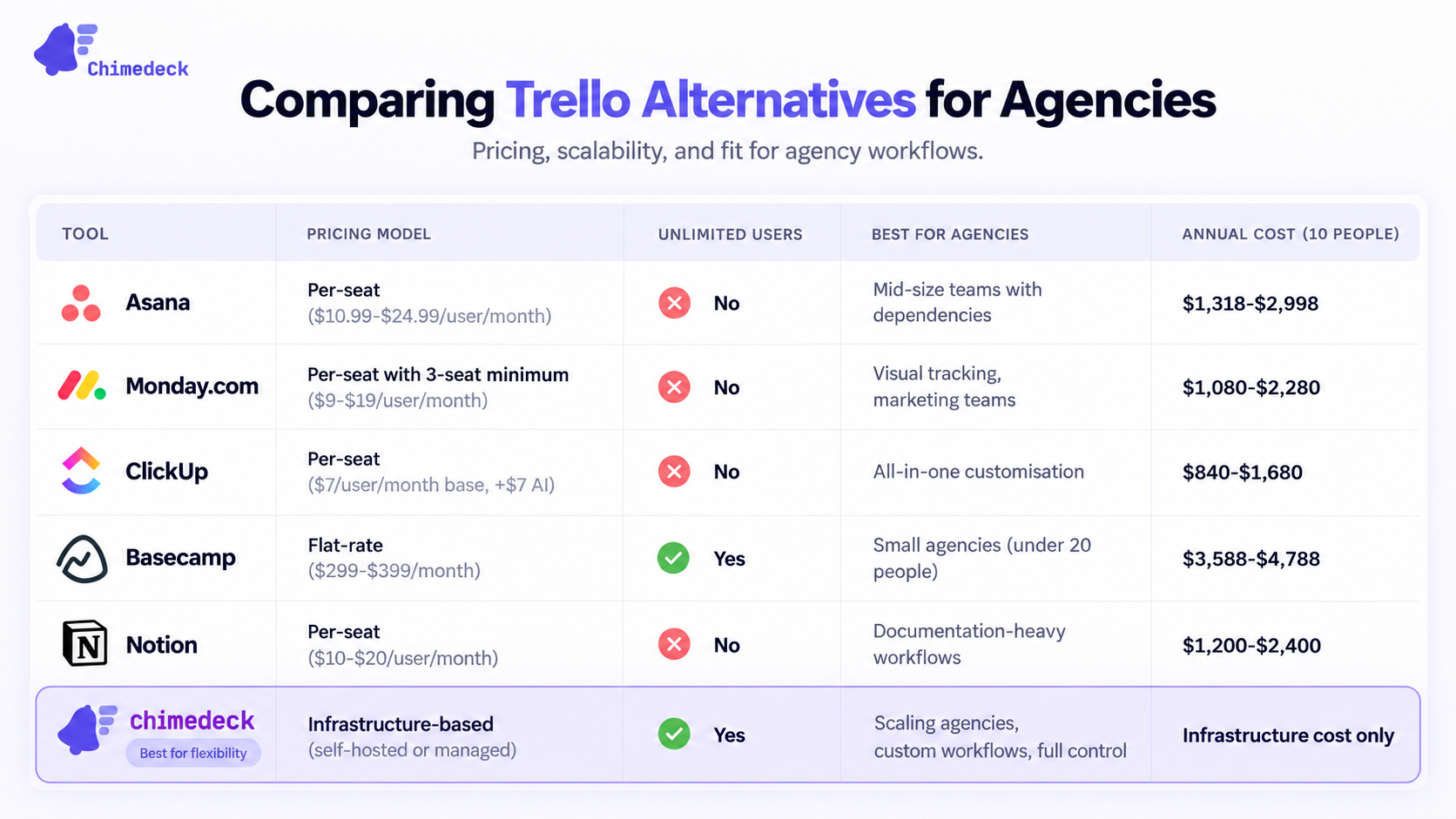
Rather than rank tools universally, the right choice depends on your specific cost tolerance and workflow requirements. Here's how major alternatives compare for agencies:
The pattern is clear: per-seat tools remain cheaper at small scale (under 15 people), but flat-rate or infrastructure-based pricing becomes advantageous as teams grow. Basecamp hits breakeven at around 20 users. Chimedeck, as an open-source option, decouples pricing from headcount entirely.
For a 30-person agency, the cost difference is material. Asana or Monday.com at $10-15 per person costs $3,600-5,400 yearly. Basecamp's $299 monthly is $3,588 regardless of team size. Chimedeck's infrastructure cost (whether self-hosted or cloud-managed) typically ranges $500-2,000 annually depending on deployment scale, making it substantially cheaper at scale.
Agency-Specific Requirements Beyond Pricing
Cost is only one dimension. Agencies need features that general-purpose tools treat as premium add-ons:
Multi-client segregation: Keeping client work confidential while maintaining visibility is non-negotiable. Chimedeck's flexible permission model allows agencies to create client-specific workspaces with fine-grained access controls, something Trello requires manual board duplication to achieve.
Workflow customisation: Different client types demand different cadences. A retainer client needs lightweight monthly check-ins. A fixed-scope project needs sprint structure and dependency mapping. Open-source platforms let agencies customise workflow states, card templates, and automation to match client requirements. Closed platforms force workflow conformity.
AI-powered operations: Modern agencies are using AI to automate routine work. Task generation from Slack messages, automated status reports, intelligent task routing based on team capacity. Chimedeck's AI-native approach embeds automation directly into workflows rather than requiring external tools like Zapier.
Integrations that stick: Agencies live in ecosystems of specialised tools. Client management platforms, accounting software, time tracking systems. Rather than waiting for tool vendors to build integrations, open-source systems let agencies build custom connectors that solve their specific operational needs.
The Open-Source Advantage for Agencies
Open-source project management systems solve a problem that SaaS vendors will never address: vendor lock-in. When you've built 3 years of client work into a proprietary system, switching costs are prohibitive. The vendor knows this. They optimise pricing for extraction, not partnership.
Open-source tools invert this dynamic. You own the data and the infrastructure. If you deploy Chimedeck self-hosted, the entire system runs on your infrastructure. Want to migrate? Extract your data. Want to customize deeply? Modify the code. Want to integrate with bespoke internal systems? Build it yourself.
This is why open-source alternatives matter to scaling agencies. You're not renting features from a vendor. You're adopting a platform you can evolve as your business changes. No surprise price increases when you hit 50 users. No forced feature migrations that break your workflows. No sales team pitching enterprise plans you don't need.
Building Predictable Operations at Scale
The real question agencies ask isn't "which tool is best?" It's "which tool will still make sense when we're twice the size?" Small agencies can live with Trello's limitations. Mid-size agencies face a cliff: either rebuild systems as they outgrow Trello, or accept higher costs and technical debt.
Growing from 10 to 30 people typically forces a tool migration. You'll outgrow Trello's simplicity around 15-20 people. You'll feel the cost burden of per-seat tools around the same inflection point. This is when agencies typically look for alternatives that won't force another migration in 18 months.
Infrastructure-based or flat-rate pricing models handle this transition smoothly. Basecamp works well for small-to-medium agencies. Chimedeck, as an open-source Trello alternative, offers the same unlimited user model with deeper customisation and control. Choose self-hosting to own infrastructure entirely, or use managed cloud deployment if you prefer operational simplicity.
The economics work at every stage. At 10 people, you pay infrastructure costs instead of $600-1,200 for Trello seats. At 30 people, the savings compound. At 50+ people, you've avoided tens of thousands in cumulative software spend while maintaining the exact workflows that drive your business.
Chimedeck - MCP Task Management Platform
Chimedeck is an open-source project management and workflow platform designed for teams that need scalability without per-seat cost friction. With unlimited users, flexible deployment options (self-hosted or cloud-managed), and AI-powered workflows, Chimedeck provides an alternative to traditional SaaS tools like Trello that charge by headcount. Built for agencies, product teams, and organisations requiring custom workflows and full infrastructure control, Chimedeck bridges the gap between simplicity and scale. It enables teams to manage complex multi-client operations, automate processes with embedded AI, and avoid vendor lock-in through open-source architecture.