Task Management for Small Business: Scaling Beyond Trello
Learn why small businesses outgrow Trello and Asana. Explore cost-efficient task management solutions that scale without per-seat pricing.

Small teams are stuck in a bind. You need a task management system to coordinate work, but traditional project management platforms are built for scaling SaaS pricing, not for scaling teams. The tools everyone recommends, Trello and Asana, start free or cheap, but the cost per user compounds quickly as your team grows. Worse, they force your workflows into rigid templates that don't match how your team actually works. Many small business owners end up paying hundreds monthly for tools they've outgrown, or juggling five different apps to patch the gaps. This is the core challenge of task management for small business: finding a system that grows with you without breaking your budget or forcing compromise on how you work.
The good news is that the best task management solutions often aren't on the mainstream comparison lists. They're built on different principles: unlimited users, flexible workflows, and the kind of control you get from open-source infrastructure. Understanding these principles changes how you evaluate tools and can save thousands in annual tool sprawl.
The Hidden Cost of Per-Seat Pricing
Most SaaS project management tools follow the same pricing model: free tier for small teams, then a cost per user per month once you grow. Trello charges $6 to $17.50 per user per month depending on features. Asana starts at $10.99 per user per month. At first, this feels manageable. A 5-person team pays $50 to $88 monthly. But when you hit 10 people, costs double. At 20 people, you're spending $220 to $350 monthly just to track tasks. Scale to 50 people and you're at $5,500 to $8,750 annually on a single tool.
This model was designed for enterprise buying where per-user cost is acceptable. For small businesses, it creates friction at exactly the point where you're growing most rapidly. You can't reduce headcount to save costs. You can't ask teams to stop using the tool. The only option is to absorb the climbing expense, which often forces difficult choices: either pay for features you don't use on a more expensive plan, or sacrifice functionality to stay on a cheaper tier.
The real problem emerges over time. As pricing climbs, you stop seeing your task management system as infrastructure and start seeing it as a line item to justify. That mindset shift, from "this helps us work" to "how much is this costing us," signals a deeper misalignment between the tool's design and your needs.

When Trello Stops Being Enough
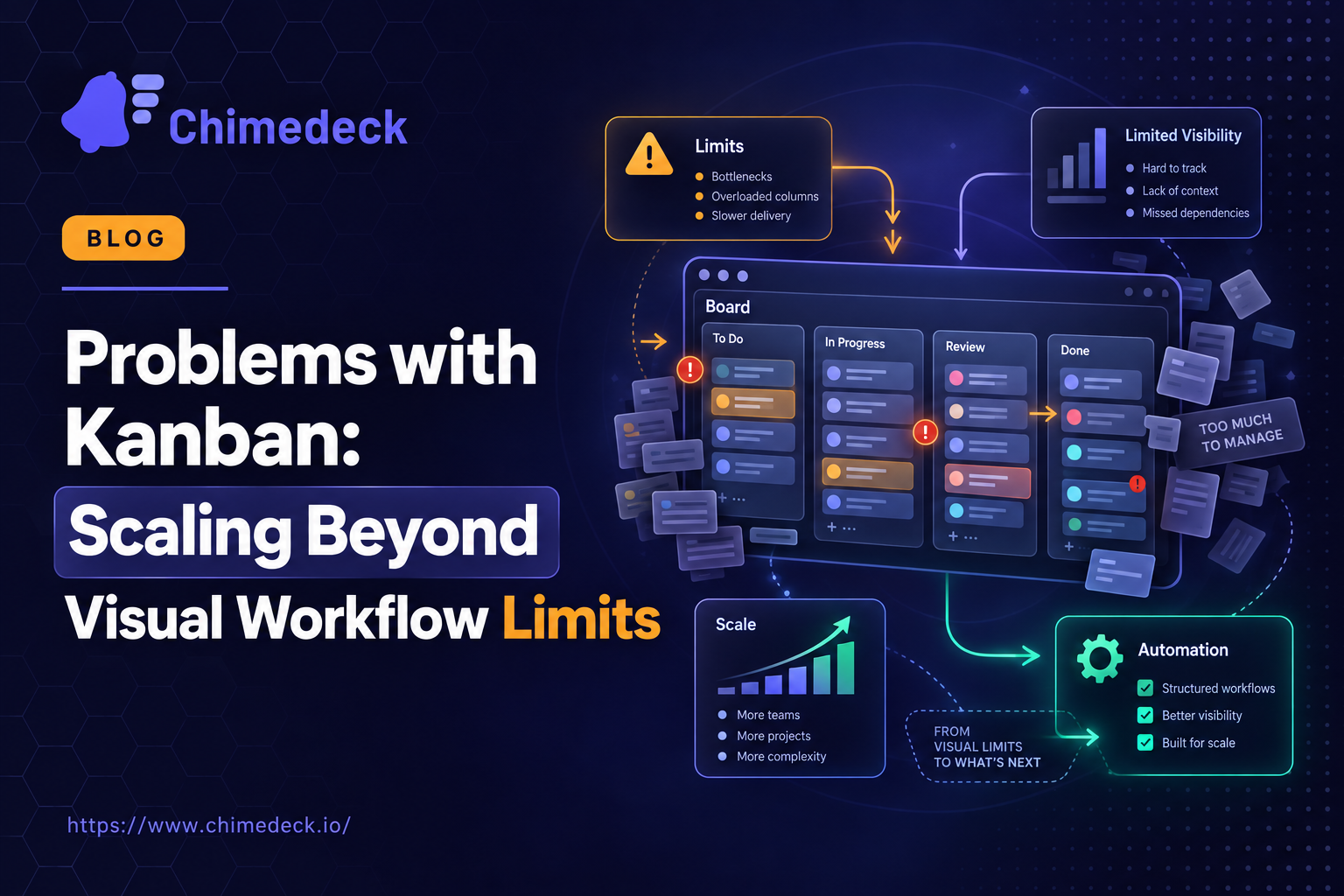
Kanban boards are intuitive. Moving cards across columns feels right. Trello is genuinely good at what it does: visualising simple workflows. But simple workflows are only half of how teams actually work. Most small businesses operate multiple workflows in parallel. Client onboarding. Content creation. Sales pipeline. Support tickets. Each has different stages, different stakeholders, and different rules for what triggers the next step.
Trello forces each workflow into cards and columns. You can add custom fields, use colour coding, attach files. But the model stays the same: cards move, people comment. When your workflow needs conditional logic, dependency management, or automated escalation, Trello becomes friction. You end up using it for visibility rather than orchestration, which defeats the purpose.
Asana solves this by offering more structure. You can build timelines, set dependencies, create custom fields, and automate status updates based on conditions. But that flexibility comes with complexity. You're now maintaining a project management system rather than using one. Small team members get overwhelmed by options. The tool stops fitting naturally into how you work and instead demands that you reshape your work to fit the tool.
Both tools face the same fundamental constraint: they're designed to work the same way for every customer. Trello trades flexibility for simplicity. Asana trades simplicity for flexibility. Neither solves the core problem for small businesses, which is having a system that reflects your specific workflows without requiring extensive customisation or integration workarounds.

The Tool Sprawl Problem
Task management for small business rarely stays contained to one tool. You start with Trello for visibility. Then add Slack for communication. Then Zapier to connect them. Then Google Sheets for data analysis that Trello can't do. Then you add a CRM because Trello doesn't handle sales workflows. Then a time tracking tool because you need billable hours. Then calendar integration to prevent schedule conflicts. Each tool is best-in-class for its function, but together they create operational friction.
The cost compounds. Five tools at $100 monthly each is $500. But the real cost is switching context. Your team logs into multiple systems daily. Data exists in multiple places, sometimes conflicting. Automations break because systems don't integrate cleanly. Someone inevitably makes a change in one tool and forgets to update another. Visibility fragments. Accountability becomes fuzzy. The system you built to improve coordination actually creates coordination tax.
This is why teams start looking beyond the mainstream tools. The problem isn't that Trello is bad. It's that building on top of fragmented systems is expensive, both in time and in money. Small business operators start asking: why am I paying for five tools when I need one system that can coordinate workflows end-to-end?
What Scalable Task Management Actually Looks Like
Once you've felt the pain of per-seat pricing and tool sprawl, the criteria for evaluating task management shift. Cost efficiency becomes non-negotiable. Flexibility becomes essential. You start looking for fundamentally different architecture.
The best task management systems for small business share certain characteristics. First, unlimited users. Your team shouldn't face a cost penalty for growing. If adding someone to the team increases monthly spend, growth becomes financially painful. Second, flexible workflows. The system should accommodate how you work now and adapt as your processes evolve. You shouldn't need a consultant to reconfigure the tool every time your workflow changes. Third, built-in automation. You shouldn't need to bolt on Zapier to automate routine work. Conditional logic, status transitions, notifications, and escalations should be native to the system.
Fourth, deployment flexibility. Ideally, your task management system should run where you want it to run: in your cloud, on your servers, or in managed hosting. This isn't just about data privacy (though that matters). It's about avoiding vendor lock-in and maintaining long-term control. Fifth, AI-powered capabilities. As workflows mature, you need intelligence baked into the system: suggested task assignments, workflow optimisation, pattern detection, automated categorisation. These shouldn't require external tools; they should be part of the platform itself.
Most of the mainstream tools check some of these boxes. None check all of them. That's because they're optimised for a different customer: fast-growing SaaS companies with large budgets that can absorb per-user costs. For small business task management, you need different infrastructure.

Open-Source and Self-Hosted Solutions
This is where the conversation shifts to open-source alternatives. Open-source task management platforms have historically been the domain of technical teams that didn't mind the maintenance burden. That's changing. Modern open-source workflow systems are designed for operators, not just developers. They're stable, well-documented, and built for real-world complexity.
The advantages are substantial. You own the code. You're not locked into a vendor's product roadmap. You can customize workflows without requesting features or waiting for product updates. Your data lives where you choose: on your own infrastructure, your preferred cloud provider, or managed hosting. If the project becomes unmaintained, you have the source code; you're not abandoned. And critically, there's no per-seat cost. A thousand users cost the same as ten.
The trade-offs are real. You need to manage infrastructure or pay for managed hosting, which requires operational discipline. The community might be smaller than Asana or Trello, so you may have fewer integration options out of the box. Documentation may be less polished. These aren't deal-breakers for small teams, especially those that have experienced the pain of tool sprawl. But they're important to acknowledge.
For small businesses that have grown to 15–50 people, where per-seat pricing is noticeably expensive and flexibility is critical, open-source becomes a rational choice rather than a technical preference.
Building Task Management Systems That Grow With You
The shift from "which tool should we use" to "what architecture do we need" is the inflection point where small business task management becomes strategic. You stop shopping for features and start evaluating infrastructure.
Start by mapping your actual workflows. Not theoretical workflows. Real ones. Where are decisions being made? Where are handoffs happening? Where is context getting lost? Where are you working around tool limitations? Once you see the real shape of your work, tool evaluation becomes easier. You're matching system capabilities to actual needs, not to marketing claims.
Evaluate vendor lock-in explicitly. If you move to a new tool in three years, how easily can you extract your data? Can you export histories? Are custom fields portable? If the answers are fuzzy, that's a cost you'll pay later. This is especially true for task management tools that become central to your operations.
Price your true total cost of ownership. Include not just the monthly subscription, but the cost of integrations, the time spent on setup and configuration, the time cost of your team context-switching between systems, and the risk cost of data fragmentation. A tool that's cheaper per user but requires five integration tools and creates data silos is often more expensive overall than a more integrated alternative.
Consider deployment flexibility. For most small businesses, managed cloud hosting is the right balance: you get infrastructure management without the operational overhead of self-hosting. But as you scale or face compliance requirements, the ability to self-host becomes valuable. Choose systems that offer both.
Finally, think about AI and automation as table stakes. You're not just buying a tool for today; you're building infrastructure for your future operations. Task prioritisation, workflow optimisation, resource allocation, smart categorisation: these capabilities matter more the larger your operation becomes.
A Better Foundation for Small Business Workflows
The market position of Trello and Asana has created an assumption that task management is a solved problem. It's not, at least not for small businesses that have outgrown simple workflows. The constraint isn't features. It's architecture. The constraint is being locked into a cost model that penalises growth, a feature set that doesn't match your actual workflows, and a system where visibility and automation are bolted together rather than integrated.
When you step back from the mainstream conversation, you see that the most cost-efficient and flexible task management solutions are often built on open-source infrastructure with unlimited users, flexible workflow design, and AI-powered capabilities built in. These aren't niche technical products anymore. They're becoming the foundation that serious small businesses choose when they're ready to stop juggling tools and start building unified systems.
The best decision isn't to pick the most popular tool. It's to identify what your team actually needs to coordinate work, then find the simplest system that delivers exactly that without imposing cost scaling, inflexible templates, or tool sprawl. For many small teams, that leads somewhere unexpected: to open-source alternatives that give you cost control, workflow flexibility, and the kind of system ownership that becomes critical as you grow.
Frequently Asked Questions
What's the best task management tool for a small team of 5 people?
For a 5-person team with simple workflows, Trello or even a well-organised spreadsheet works fine. The tool matters less than clarity on who owns what and when it's due. If your workflows are more complex, Asana or a self-hosted free Trello alternative might be better. The key is matching complexity to what your team actually needs rather than paying for features you won't use.
When should a small business switch away from Trello?
Switch when you're using multiple boards for different workflows and spending more time managing the tool than benefiting from it. If you're adding multiple integrations to patch gaps, or if your team is frustrated by lack of automation, it's time to explore more flexible systems. Typically this happens around 10–15 people or when your workflows become multi-stage and cross-functional.
Is open-source task management reliable for business use?
Yes, if you choose actively maintained projects with commercial support options. Look for products with clear update schedules, documented APIs, and communities that include businesses (not just hobbyists). The trade-off is operational responsibility: you need to manage updates and infrastructure or pay for managed hosting. But reliability is absolutely achievable.
Can I avoid paying for per-user task management software?
Yes. Open-source and self-hosted solutions with unlimited-user models exist. Some commercial tools also offer unlimited-user pricing. The catch is typically less polish, fewer integrations, or operational overhead. It's a reasonable trade-off if cost scaling is your primary concern and you have the ops discipline to manage it.