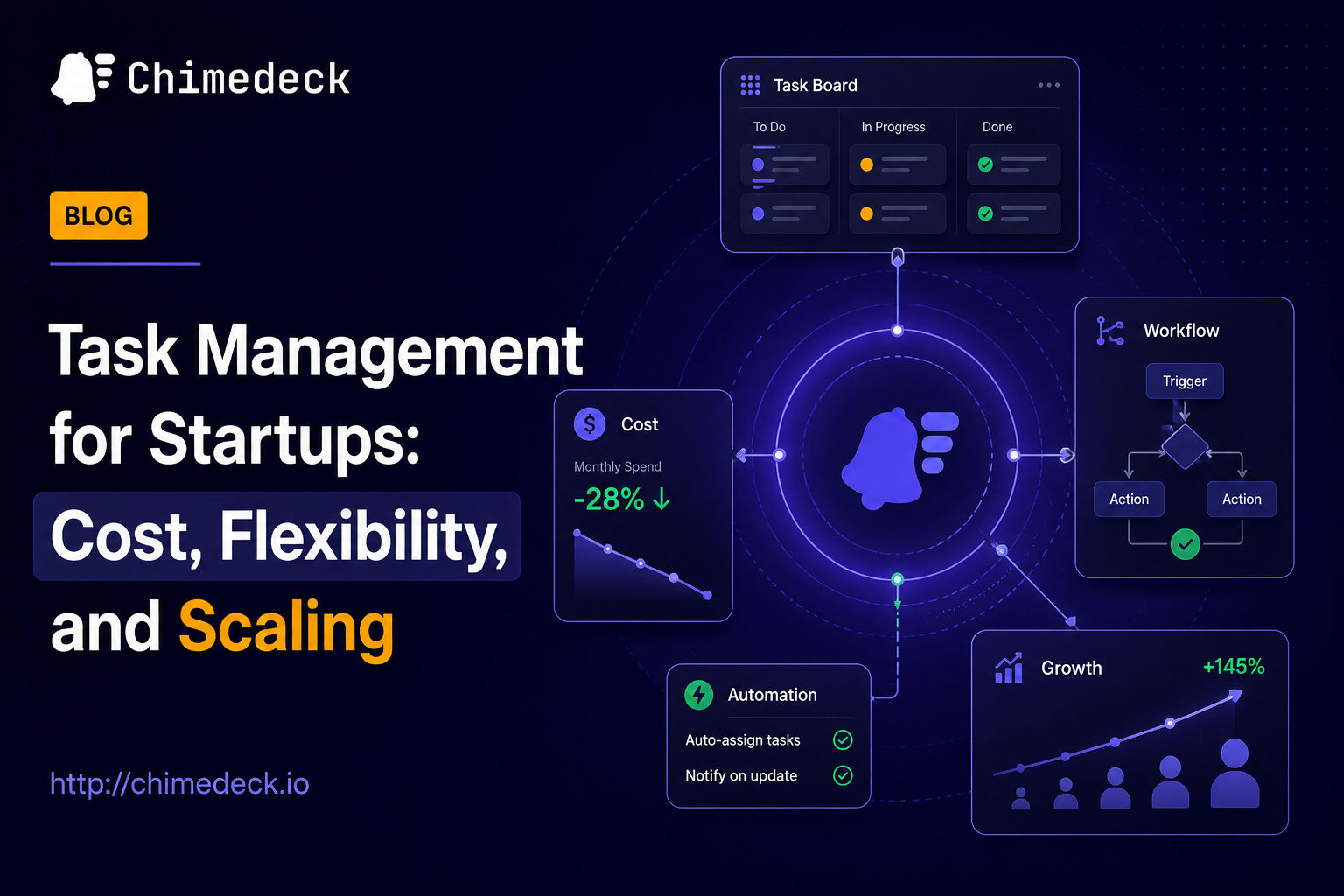
Task Management Process: Build a System That Scales
Learn how to build a task management process that scales with your team — covering workflow stages, SaaS cost trade-offs, AI automation, and open-source tools.

Most teams don't have a task management problem at the start. At ten people, things stay manageable. Someone messages the team, tasks get done, projects ship. The cracks appear somewhere around twenty people, or three simultaneous client accounts, or the moment you realise work is falling through the gaps and nobody can explain exactly why. The task management process that worked at five people doesn't hold up at fifty, and the cost of that mismatch shows up as missed deadlines, duplicated effort, and a growing stack of coordination overhead that nobody owns.
The real challenge isn't understanding what task management is. Most people can tell you it involves tracking work from start to finish. The harder problem is that most teams have a process that was stitched together rather than designed, built around tools that made sense early on but now add friction rather than remove it.
When Your Task Management Process Starts to Break
The early stages of building a team are forgiving. Email threads, shared docs, and a simple kanban board are enough when the workflow is shallow. Tools like Trello work well in this context because the model is intuitive: create a card, move it through columns, mark it done. That simplicity is a genuine strength when you have a handful of people and a limited set of active projects.
The problems emerge as complexity grows. You're running five client accounts simultaneously, onboarding new team members every quarter, and managing work across marketing, product, and operations at the same time. The task management process you built for simplicity now requires workarounds at every turn. You're paying per seat across two or three SaaS platforms to cover the gaps between tools, and that cost compounds as the team grows. The workflow is starting to work around the tools rather than the other way around.
The structural issue is that most popular tools were designed around individual productivity or small-team use cases. They were not built to function as an operating layer for a growing, cross-functional team that needs flexible workflows, real-time visibility across projects, and automation at its core. Reaching that ceiling is not a failure of process discipline. It's a signal that the system needs to change.
=>>> Read More: Task Management Meaning: What It Really Means for Teams
What a Functional Task Management Process Actually Looks Like
A mature task management process is more than a list of to-dos. It's a system with clearly defined stages: task creation and scoping, prioritisation, assignment, execution, review, and closure. Each stage has inputs and outputs. When any stage is poorly defined or inconsistently applied, the downstream effects compound quickly. A task without a clear owner gets delayed. A task without a realistic deadline gets deprioritised. A task without a review step gets shipped with errors.
The components that matter most in practice are assignment clarity (one owner per task, not a shared responsibility), priority signals that everyone understands, deadlines with buffer built in for review cycles, and a status model that reflects how work actually moves through the team. Not an abstract to-do, in-progress, done column structure, but a set of stages that map to your actual delivery workflow.
Methodologies like Kanban, Scrum, and Getting Things Done (GTD) each address part of this. Kanban gives visual clarity on flow and bottlenecks. Scrum enforces cadence and accountability for sprint-based teams. GTD works well for high-volume individual work where cognitive load management is the main constraint. But the methodology is secondary to having a system that enforces it consistently. Relying on everyone to remember the process on a busy Monday is not a system. It's an aspiration.
=>>> See more: Task Management Framework: Which One Is Right for Your Team?
The Cost Problem With Standard SaaS Tools

Per-seat pricing made sense when SaaS was competing against expensive on-premise software. The comparison was favourable: pay monthly per user instead of a large upfront licence. That framing no longer applies to most teams, but the model has stuck.
For agencies, fast-growing startups, and any team that regularly brings on new contributors, per-seat costs become a significant and unpredictable overhead. A twenty-person team paying across two or three tools can easily spend over $600 per month before integrations and add-ons. Scale that to forty people with client accounts across multiple platforms, and the cost is significant enough to appear in budget reviews. Worse, the pricing model creates a structural disincentive to collaboration. Teams start managing access to control costs, which creates information silos, which undermines the core purpose of having a shared task management process in the first place.
The teams that feel this most acutely are the ones growing fastest. The moment you're penalised for adding people, you're choosing between scaling the team and scaling the tool cost. That is a trade-off that should not exist.
Where AI Fits Into Modern Task Management Workflows
Most teams are still at the early stages of figuring out where AI genuinely helps in operations. The obvious applications are content generation and code review, but AI has a less-discussed role inside workflow management: intelligent task generation for repeatable processes, dependency mapping, workload-based prioritisation, and automated handoffs between team members when a stage is complete.
A well-structured task management process in 2025 should not require a human to manually create and assign every task from scratch. If your team runs a repeatable workflow, whether it's a client onboarding sequence, a content production pipeline, or a software release cycle, those workflows should be largely automated. The system should generate the tasks, assign them based on current capacity, and surface blockers before they become delays.
Most standard SaaS tools treat automation as an add-on. It's built on top of the core product, usually requiring third-party services to connect what should already be integrated. That architectural choice creates brittleness. When your automation relies on three separate services staying in sync, you're adding operational risk rather than reducing it. AI-native workflow automation needs to sit inside the product itself, not be bolted on through an integration layer.
Building a Task Management System That Scales
Teams that outgrow Trello or Asana are often looking for something that handles more complexity without immediately breaking the budget or requiring significant engineering effort to maintain. That is a real and underserved gap: teams want the usability of familiar kanban-style tools combined with the flexibility to adapt workflows as the business changes.
A task management tool designed for scale should handle boards, lists, and assignments as baseline functionality, but also support custom workflows, multi-project views, and automation natively. Not as a paid tier or through a third-party integration. Teams managing multiple clients or running parallel workstreams need a system that adapts to how they work, rather than requiring them to bend their process to fit the tool's constraints.
Open-source platforms address a concern that's becoming more common among teams handling sensitive data or operating in regulated environments. When your entire workflow history lives in a vendor's cloud, you're dependent on their data handling, their pricing decisions, and their product roadmap. Self-hosted deployments remove that dependency entirely.
If you're evaluating options for a growing team, the criteria that matter most are: does the system support the way your team actually works, can it grow with your headcount without a proportional cost increase, and does it give your team the automation capabilities to handle what the system should handle rather than what people need to remember to do manually. Chimedeck is built around exactly these constraints: an open source Trello alternative with unlimited users, flexible deployment options including self-hosting, and AI-powered workflow automation built into the product rather than added on top. For teams that have outgrown their current setup and need a free Trello alternative that scales without scaling the bill, it's worth a close look.
Getting the task management process right is an ongoing calibration of method, tooling, and team behaviour. But starting from a foundation that doesn't penalise growth and gives you the flexibility to automate the repeatable parts makes everything downstream significantly easier to manage.
=>>> Related Post: Benefits of Task Management Software | Chimedeck
Frequently Asked Questions
What are the main stages of a task management process?
A well-structured task management process typically moves through six stages: task creation and scoping, prioritisation, assignment, execution, review, and closure. Each stage should have a clear definition of what done looks like before moving to the next one.
When should a team move beyond basic tools like Trello?
The signal is usually when your team starts building workarounds inside the tool rather than workflows. Common indicators include managing access to control per-seat costs, using multiple tools to cover feature gaps, or spending more time updating the system than actually doing the work it's meant to track.
How does AI improve task management workflows?
AI adds the most value in repeatable processes where task generation, assignment, and handoffs can be automated rather than manually triggered. This reduces coordination overhead and frees team members to focus on execution rather than administration. The key is having AI embedded in the workflow system itself, not as an external add-on.
What is the difference between task management and project management?
Project management is the broader practice of planning, resourcing, and delivering a project from initiation to completion. Task management is the operational layer within that, focused on how individual pieces of work are created, assigned, tracked, and completed. Strong task management is what makes project management actually function in practice.